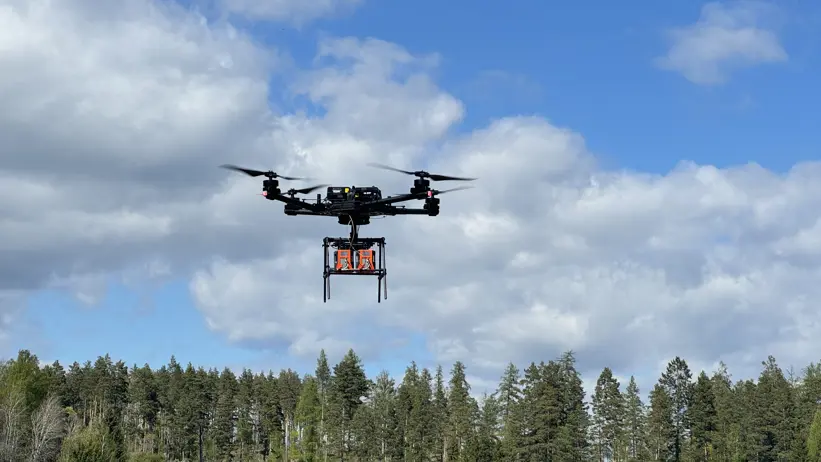
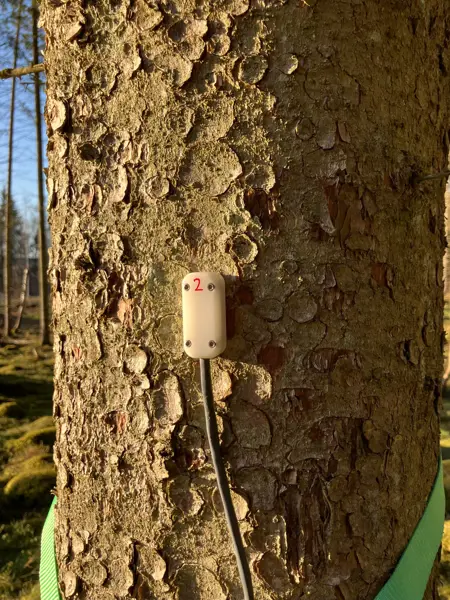
The researchers used so-called sap flow sensors to measure water transport within the trees. Photo: Luiz Henrique Elias Cosimo.
Why bark beetle infestations can be difficult to detect from the air
News published:
15/10/2026
Spruce trees can continue to transport water and function much like their healthy neighbours for several weeks after a bark beetle attack. A new study from the Swedish University of Agricultural Sciences (SLU) highlights what this means for early detection from the air:
during this period, there is simply no stress signal for the cameras to detect.
Since 2018, the spruce bark beetle has caused damage costing several billion kronor (SEK). Detecting infested spruce trees early could help limit its spread, and researchers have spent years exploring how to identify these trees from the air at an ever-earlier stage.
The SLU team combined continuous measurements of water transport in mature spruce trees with repeated hyperspectral drone images to link changes inside the trees with signals detected in their canopies.
The drone was used to detect subtle changes in the reflection of light from the tree canopy, which reveal physiological changes in the trees. Photo: Langning Huo.
An unusually difficult process to monitor
The researchers used sap flow sensors to measure how much water moved through the trees every few minutes. Following trees from before an attack until they die is difficult: sensors must be in place before the beetles attack the tree, yet predicting which trees they will target is extremely challenging. In this study, the team captured the entire sequence for the first time in both healthy and infested mature spruce trees.
“We were able to monitor the same trees whilst they were functioning normally, after they had been infested, and as their water transport subsequently deteriorated. This progression is extremely difficult to observe in mature trees in the field,” says Jose Gutierrez Lopez, a tree physiologist at SLU, who was responsible for the sap flow measurements.
A biological barrier to early detection
The measurements revealed that water transport could collapse abruptly after several weeks of normal functioning. These findings offer a possible explanation for why remote sensing has struggled to detect infestations during the very first few weeks, despite research into different sensors, wavelengths, algorithms and machine learning methods.
“During this period, the problem is not that the remote sensing method is inadequate. The stress signal in the tree has simply not yet developed,” says Langning Huo, project leader and associate professor of forest remote sensing at SLU, adding:
“We should not spend unlimited resources trying to improve the accuracy of remote sensing during a period when the tree itself has not yet begun to show signs of physiological stress. A more meaningful goal is to identify the earliest moment when function begins to change and then ensure that we can reliably detect that transition from above.”
An infestation is not the same as stress
The sap flow measurements showed that trees began to deteriorate at different times. Some lost water transport capacity relatively quickly, while others retained part of it for much longer. Previous studies of bark beetle detection have generally measured time since infestation or beetle swarming, rather than since the tree began to lose function.
“This study showed us that the remote sensing method is only half the story. An infested tree is not automatically a stressed tree. To understand when an attack can be detected, we need to follow how the tree’s condition changes, not just know when the beetles arrive,” says Luiz Henrique Elias Cosimo, a PhD student at SLU and the study’s lead author.
The team collected drone images using a hyperspectral camera, which divides reflected light into hundreds of narrow bands that can reveal subtle physiological changes. Complete collapse of water transport could be detected almost immediately through changes in reflectance near 530 nanometres, in the green part of the spectrum. Known as the “green shoulder”, this region has proved sensitive to early tree stress in previous SLU research.
Linking these canopy signals to changes inside the tree could help develop more reliable methods for detecting infestations while intervention is still possible. It also sets realistic expectations for how early detection can be achieved.
Sap flow sensor mounted on the tree. Photo: Luis Henrique Elias Cosimo. New clues to what cause the collapse in water transport
The sequence of events also provides clues as to what drives the rapid collapse in water transport. If the bark beetle’s feeding were the direct cause, the decline in water transport should follow the beetle’s life cycle. Instead, it sometimes collapsed long before the new generation was ready to emerge from the bark.
This suggests that blue stain fungi, whose spores are carried by the bark beetles, are a more likely immediate cause. The fungi can spread from the bark into the sapwood and disrupt the tissue that transports water through the stem.
“We did not measure the spread of the fungus directly, so we cannot prove that the fungus caused the collapse. However, the timing strongly suggests that it is the fungus’s disruption of the xylem, rather than the beetles’ feeding itself, that is the likely cause of the rapid loss of water transport,” says Jose.
Hyperspectral and multispectral sensors measure light across several different parts of the light spectrum simultaneously, including beyond the visible light spectrum.
Multispectral sensors divide the light into 5–9 bands, providing a good overview.
Hyperspectral sensors divide the light into hundreds of very narrow bands, providing more detailed information.