
Why Ditches Matter: A Research Perspective
Ditches are a defining feature of many landscapes. Though often overlooked, they play an essential role in water and soil regulation. As climate change accelerates, understanding how ditches function, and how we manage them, has never been more important.
Ditches are engineered features, cut into the landscape to move water. They may be modest constructions but are powerful drivers of ecological and hydrological processes. They are exposed to negative impact and may amplify water quality problems as well as reduce them.
Climate change is increasing pressure on ditch systems
Whether in agricultural fields, forests, or urban neighbourhoods, ditches will be affected by climate change. Future climate conditions are expected to bring:
- more intense rainfall,
- more frequent and extreme flood events,
- and longer and more severe dry periods.
These shifts create hydrological responses in ditch networks. Ditches will fill more often and sometimes overflow, contributing to flooding of surrounding landscapes. Many existing systems will quickly become underdimensioned.
Research, restoration, redesign and maintenance of ditches is therefore increasingly necessary.
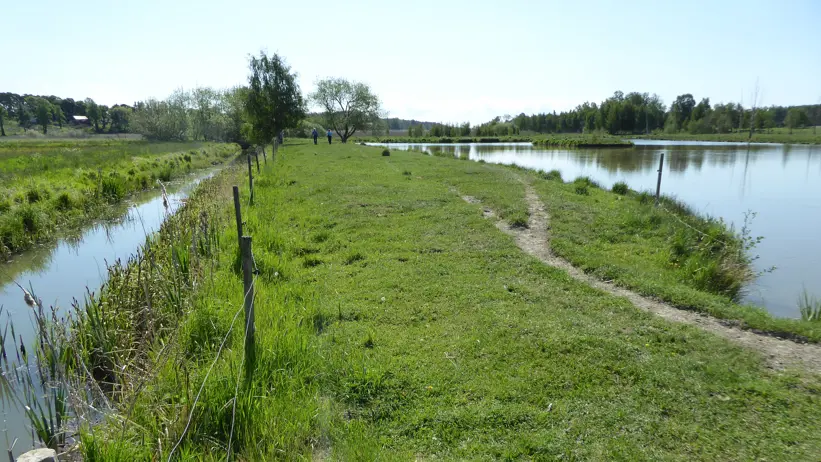
Ditches and food production
Food production depends heavily on how well we manage water.
These numbers are likely to increase as climate change intensifies dry periods in some regions and extreme rainfall in others.
Ditches are central to both irrigation and drainage systems, and thus to the stability of global food production.
Well-functioning ditches also contribute to soil quality and long-term soil health, which are critical foundations for sustainable agriculture. Ditches often transport large amounts of nitrogen, phosphorus, organic matter, and pesticides.
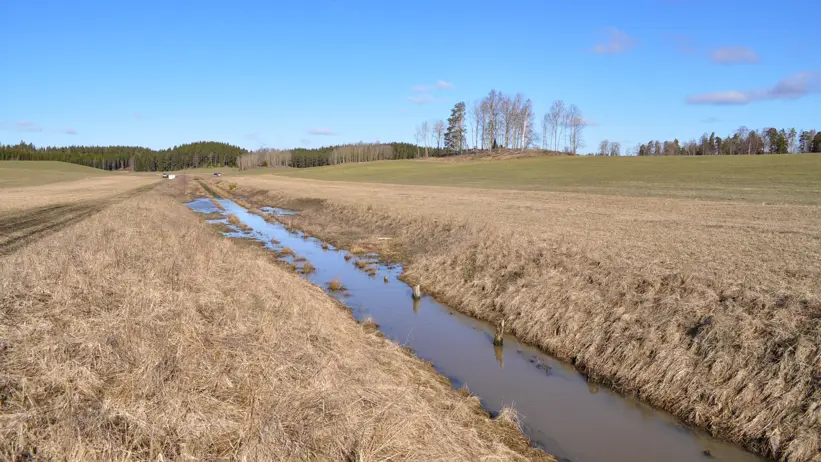
Ditches as hotspots of carbon cycling
Ditches sit at the boundary between land and water; an interface characterised by high biological activity. This means ditches receive substantial amounts of organic matter and nutrients from their surroundings.
Given that ditches sometimes occupy 5% or more of the total landscape they play a significant role in landscape-scale greenhouse gas budgets. Capturing the full climate impact of a landscape therefore requires including ditches and their surrounding soils.
Ditch management
While much effort has gone into stream and river restoration, ditches have received far less attention. This means there is untapped potential for improvement. Emerging strategies include creating multi-functional ditches that retain nutrients, enhance biodiversity, and slow water flows to reduce flood risk.
Poor maintenance can worsen water quality by transporting sediments, nutrients and contaminants.
Ongoing research aims to determine how ditch design and management can support these ecosystem services across different landscapes. It is also important to consider ditches from a landscape perspective - although individually small, ditches form dense networks that can profoundly influence hydrology, water quality, biodiversity, and greenhouse gas emissions at the landscape scale. Considering ditches as isolated features misses their cumulative impact.
--
As climate change accelerates and pressure on food production grows, ditches will become even more crucial for managing water, protecting soil, improving water quality, and reducing climate impacts.
By developing new maintenance strategies, improving design, and integrating ditches into broader landscape management, we can unlock their potential as valuable environmental assets.
SLU Ditch maps
SLU Ditch Maps are high-resolution maps created using artificial intelligence (AI).
Scientific publications
Bieroza M., Hallberg L., Livsey J., Prischl L-A. and M. Wynants (2024), Recognizing Agricultural Headwaters as Critical Ecosystems. Environmental Science and Technology, doi/epdf/10.1021/acs.est.3c10165.
Clifford, C., Bieroza, M., Clarke, S.J. … & Peacock, M. (2025). Lines in the landscape. Commun Earth Environ 6, 693. https://doi.org/10.1038/s43247-025-02699-y
Hallberg L, Hallin S, Bieroza M, 2022, Catchment controls of denitrification and nitrous oxide production rates in headwater remediated agricultural streams. Science of the Total Environment, 156513, doi.org/10.1016/j.scitotenv.2022.156513.
Hallberg, L., Djodjic F, Hallin S, and M. Bieroza (2024), Trade-offs between nitrogen and phosphorus removal with floodplain remediation in agricultural streams. Water Research, doi.org/10.1016/j.watres.2024.121770.
Peacock, M., Audet, J., Bastviken, D., … & Evans, C.D. (2021). Global importance of methane emissions from drainage ditches and canals. Environmental Research Letters, 16(4), p.044010.
Silverthorn, T., Connolly, J., Habib, W., … & Peacock. (2026). Towards improved accounting and mitigation of greenhouse gas emissions from ditches and canals. Environmental Research Letters, 21(2), p.021001.
Contact
-
Person
-
PersonMartyn Futter, Senior LecturerDivision of Geochemistry and Hydrology
-
Person
-
Person