
3-dimensional computer vision model for horses
KEY POINTS- Computer vision with a 3D-model has several potential applications in e.g. smart health monitoring, conformation and body condition scoring, behavioural studies, etc…
- The model is based on data collected from a large number of horses scanned in a custom-built 3D-scanner
- Do you and your horse want to contribute to the project? Please contact us at horsescanner@slu.se
Project overview
Participants
Short summary
A project aiming to facilitate modernization of horse keeping and veterinary care through developing the world’s most intelligent AI system for horses.
Project aim
The overarching goal of this project is to advance the modernization of equine management and veterinary care by developing the world’s most intelligent AI system for horses. Specifically, we aim to finalize and optimize a unique three-dimensional parametric horse model that our international research group has been developing over the past five years. This model holds potential for applications such as smart health surveillance, conformation and weight classification, behavioural analysis, and beyond.
How the model works
At the heart of this project is a smart 3D model that can create a digital version of an individual horse—just from a regular photo or video. This digital horse is built using a body mesh, a kind of flexible wireframe that adjusts to match the horse’s unique shape. What makes this possible is the model’s deep knowledge of horses’ body conformation variations. To teach the model this, we’ve used advanced 3D scans of real horses—thousands of data points that capture the fine details of their bodies and postures. These scans help the system learn the natural variation in shape across breeds, ages, and training levels.
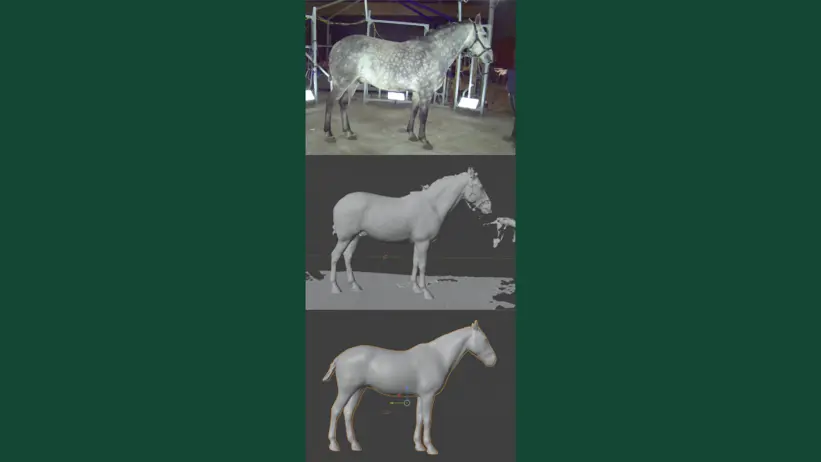
Background
Modern horse management faces increasing complexity as it strives to optimize performance, ensure welfare, and respond to societal expectations. The demands of housing, feeding, training and healthcare must be balanced carefully in a species that is both an athlete and a sensitive prey animal. Horses are exceptional in that they frequently perform athletic work at the limits of their physiological capacity. Due to their evolutionary history as prey animals, they tend to conceal injuries, which often leads to delayed diagnosis and treatment.
Ensuring effective, evidence-based, and technology-supported equine management and healthcare represents a key goal – but also a significant challenge – for the equine sector. Artificial intelligence has the potential to accelerate such development. However, AI must be built on the foundation of appropriate biological and technological knowledge and be accessible not only to veterinary specialists but to every horse owner.
Collaborations
The model is developed in cooperation with researchers at:
- Max Planck Institute for intelligent systems in Tübingen
- Institute for Applied Mathematics and Information Technologies in Milano
- The Royal Institute of Technology in Stockholm