
Biodiversity, microclimate, and habitat heterogeneity of managed riparian forests
Project overview
More related research
Global goals
- 6. Clean water and sanitation
- 13. Climate action
- 14. Life below water
- 15. Life on land
Short summary
Riparian forests are biodiversity hotspots and provide cool, stable conditions that protect many species in a changing climate. This project investigates how forest structure and microclimate influence plants and insects, and how alternative management can conserve biodiversity.
Riparian forests – the vegetation along streams and small waterways – are among the most ecologically important habitats in boreal landscapes. They provide leaf litter, dead wood and nutrients to streams, regulate water temperature through shading, and serve as dispersal corridors and climate refugia for many organisms.
Despite this importance, buffer zones along waterways in managed forests are often narrow or absent, and the ecological consequences of such management remain insufficiently understood.
In particular, we lack understanding of how forest structure influences microclimate (temperature, humidity, light and soil moisture) and how this, in turn, affects biodiversity.
This project aims to link biodiversity, microclimate and habitat heterogeneity in managed riparian forests. The project combines observational studies, experimental forest management trials and the development of monitoring tools.
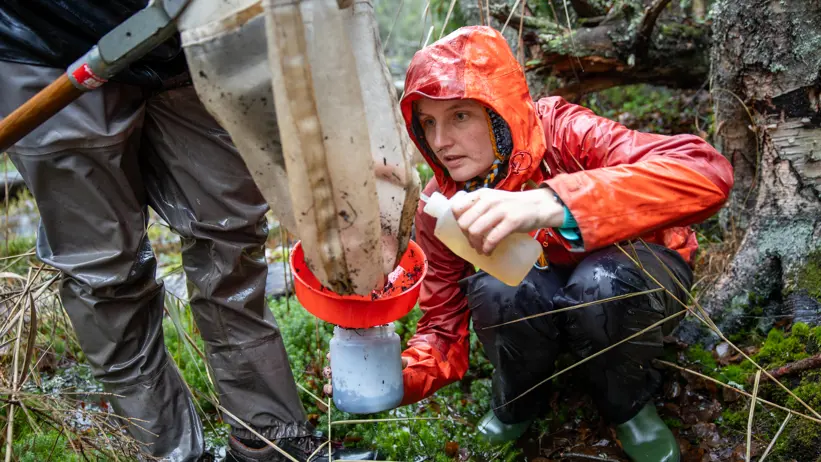
First, we analyze extensive field data from more than 20 forest sites in central and northern Sweden, including detailed inventories of riparian plants and aquatic and terrestrial invertebrates, alongside high-resolution measurements of microclimate and structural habitat features such as dead wood, canopy structure and topography. We test the hypothesis that cool, moist environments and structurally diverse habitats support higher species richness.
Second, we experimentally evaluate how different forest management approaches affect these relationships. Treatments include standard narrow buffers, selective logging that mimics natural small disturbances, and larger canopy gaps, each implemented with varying buffer widths. Using a before-after-control-impact design, we assess how these interventions influence microclimate stability, habitat heterogeneity and biodiversity. The goal is to determine which practices can both preserve climate refugia and enhance ecological diversity.
Third, the project develops practical monitoring tools. By integrating ground-based sensors with drone-based laser scanning (LiDAR) and multispectral imaging, we test whether remote sensing can detect habitat quality and predict biodiversity across larger forest landscapes. This could enable efficient evaluation and conservation planning across Sweden’s extensive forest water networks.
Overall, the project will provide evidence-based recommendations for riparian forest management under a changing climate and contribute to more resilient boreal ecosystems.
Research team
PhD student: Ernie Haglund, Department of Forest Ecology and Management
Main supervisor: Eliza Maher Hasselquist, Department of Forest Ecology and Management
Assistant supervisors:
Lenka Kuglerová, Department of Forest Ecology and Management
Jonas Bohlin, Department of Forest Resource Management
Project period: May 2025 – April 2028
This project is part of WIFORCE – the Wallenberg Initiative in Forest Research, funded by the Knut and Alice Wallenberg Foundation.