
Five tons of green fish in the counter
Project overview
More related research
Short summary
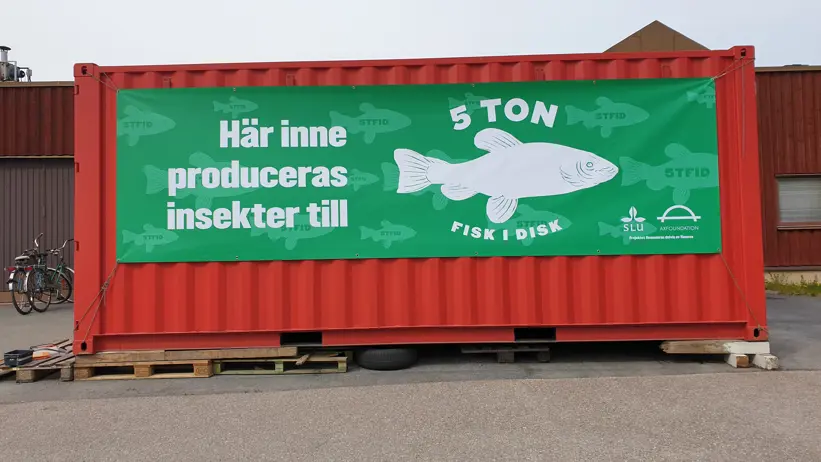
“5 Ton Fisk i Disk” was a major development project involving SLU, the Swedish food industry, the retail sector, and Grythyttan (Örebro University) that focused on the future of environmentally friendly gourmet fish feed based on a circular economy.
The Ax Foundation, in collaboration with SLU, led a 25-million-SEK initiative—funded by the industry, municipalities, the Swedish Research Council Vinnova, and the Kamprad Family Foundation—to develop the next generation of farmed fish from Sweden, based on circular systems and environmentally friendly feed. This knowledge could ultimately benefit all farm animals and pets.
The project’s gastronomic component was based on a new collaboration between SLU and Grythyttan, Örebro University (OrU), where the gastronomy and sensory analysis of chefs and researchers were combined with the very latest in life sciences analytical technology to understand how factors such as new feed, welfare, water quality, and handling during and after harvest can be combined to produce not only environmentally friendly food, but food of the highest gastronomic quality.
Project aim
The four main objectives of the project were:
- Produce at least 5 tons of Swedish environmentally friendly rainbow trouth of the highest gastronomic quality, to be marketed by Axfood and Fiskhallen Sorunda.
- Produce a recycle based feed without importing any new nutrients into the Baltic basin
- To support the development of Swedish recycle-based feed raw materials.
- To support Swedish municipalities' environmental work as part of circular food production.
5 tons of green fish in the counter aims to produce a sustainable and circular fish feed that also provides tasty fish. The feed is produced from residues from retailor, the food industry, the forest and "blue catch crops" by means of insect composting, microbial fermentation and filtering organisms. This may include, for example, shells and kernels from fruits and vegetables, bread wastes or residual products from forests and fields. The insects eat the residual products and the fish eat the insects when they have been converted to feed pellets. The potent fertilizer that the insects generate can be used as a plant nutrient.
The project is expected to result in:
- Increased demand for Swedish and environmentally friendly fish
- Support the development of economically profitable forms for Swedish production of alternative feed raw materials.
- That Swedish fish can be marketed as a sustainable alternative
- Increased production and sale of environmentally friendly fish.
The project was jointly funded by the Vinnova Research Council and industry and ran over two years. The goal was to create a functioning circle of production, logistics and market. To ensure that the fish also taste good, the Restaurant and Hotel school, "Grythyttan" of Örebro University, was one of the central partners. They mapped how a variety of factors, such as new types of feed and water quality, can provide food of the highest gastronomic value. SLU has produced a film that presents the first step in this work.
The project linked to three challenges in the value circle of food production:
1. To find a financially acceptable provision for waste from food production.
2. To develop environmentally friendly feed ingredients.
3. To produce environmentally friendly and locally grown fish of the highest quality.
The project included, besides academia, industry from waste management, bioprocessing, feed production and fish farming, their organizations and the academy. By bringing together actors from the entire value circle, an understanding of limitations before and after one's own part, is enhanced, which facilitates the design of a circular process flow.
Partners
The project enclosed 15 partners:
Axfoundation, SLU, Grönsaks och Fiskhallen Sorunda AB, Axfood AB, Älvdalslax AB, Sweco Environment AB, Eskilstuna Strängnäs Energi och Miljö AB, Raisio Aqua, RH Grythyttan, Örebro University (OrU), RISE Processum AB, Mycorena AB, Marine Biogas/Feed AB, Härnösands Energi & Miljö AB, Vattenbrukscentrum Norr AB, Lantmännen Lantbruk.
Project also enclosed eight associated partners, including 5 land based recirculating farms, from tropical species to aquaponics, ASC (Aquaculture Stewardship Council), Sweden, Beijer Institute, Royal Swedish Academy of Sciences, The aquaculture secretariat of the Swedish Board of Agriculture.
More information
Madeleine Linins Mörner, madeleine.morner@axfoundation.se, 070-950 35 35
Anders Kiessling, Anders.Kiessling@slu.se, 070-391 93 99
Christian Sjöland, christian.sjoland@axfoundation.se, 076-119 16 35
5 Ton Fisk i Disk was a big development project between SLU, Swedish food industry, retail industry and Grythyttan (Örebro university). The project ran between 2019 - 2021.