
The function of tree retention for biodiversity
Project overview
More related research
Global goals
- 15. Life on land
Short summary
How do trees retained after harvesting affect biodiversity over time? This project investigates how retention trees contribute to preserving species in managed forests, with a focus on lichens growing on aspen.
When forests are harvested, retention patches with living and dead trees are left as part of standard forestry practices. These trees are intended to help maintain biodiversity.
Many studies have assessed the local and short-term effects of tree retention. The aim of this project is to understand the long-term effects of retention trees on biodiversity from a landscape perspective.
This is possible to study due to the increasing time since retention forestry was first initiated.
The researchers will study how lichen communities change over time; how species establish, spread, and disappear, and relate these patterns to the characteristics of individual trees, forest stands, and the surrounding landscape.
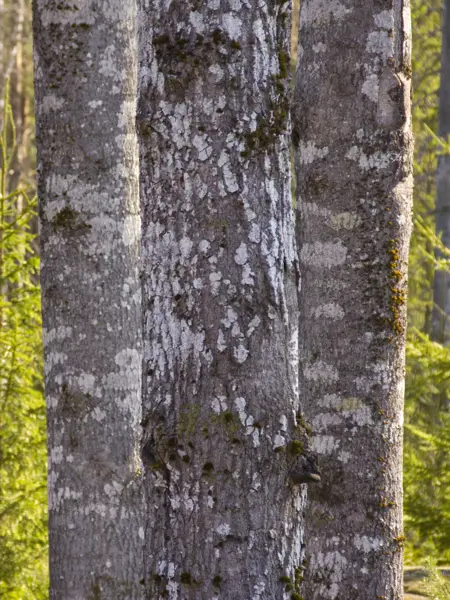
The focus is on epiphytic (tree-living) lichens on aspen. The project will test whether epiphytic lichens from previously retained trees can spread to younger trees that regenerate after clear-cutting.
A survey of lichens on aspen conducted 17 years ago by Lundström et al. (2013) will be repeated to assess whether lichens from retention trees have colonised newly established trees.
In addition to field studies, the researchers will compile existing knowledge through a literature review or meta-analysis to utilize the extensive research available to answer questions of how to apply tree retention for epiphytic lichens.
Research team
PhD student: Elin Bongcam Hermann
Main supervisor: Professor Thomas Ranius
Assistant supervisors:
Malin Tälle, Department of Ecology, SLU
Aino Hämäläinen, Deptartment of Ecology, SLU
Hanna Staland, Kopparfors skogar
Collaborating partner: Kopparfors skogar
Project period: Jan 2026 – Jan 2031
This project is part of WIFORCE – the Wallenberg Initiative in Forest Research, funded by the Knut and Alice Wallenberg Foundation.