
Lawn as Ecological and Cultural Phenomenon: Search for sustainable lawns in Sweden
Project overview
Participants
More related research
Short summary
The Lawn project researched the cultural and ecological phenomenon of lawns - the most common and popular feature of urban spaces around the world.
Background
Today, lawns cover a significant part of all green open spaces in cities (up to 70%) in, e.g., the front- and backyards of private gardens, public parks, cemeteries, and in addition golf courses and along roads. Most people of the Western world view lawns as natural elements of the urban landscape, without questioning their functional, ecological or aesthetic value. There were very few studies of the biodiversity, environmental impact, public opinion about and the historical and contemporary motives for planning and management of different types of lawns.
This project was an interdisciplinary collaboration, including stakeholders, to study lawns from different perspectives as social and ecological phenomenon in order to understand their roles in sustainable urban planning, design and management. Ecological knowledge, values and norms influence the management of urban green areas and may thus influence the environmental impact of, biodiversity in and ecosystem services provided by lawns. Potential alternative solutions are impossible to find without an understanding of the social motives behind the strong attachment of the modern Western society to lawns. The interdisciplinary approach allowed us to exchange knowledge between disciplines and to achieve a multi-dimensional understanding of the lawn as a phenomenon.
Research questions
Specific aims:
- To examine the motives for decisions about establishment and management of lawns among different stakeholders
- To research historical roots, perceptions, norms, aesthetical and design values of current management practices of lawns
- To examine general coverage of lawns in Swedish cities
- To analyse environmental impact (carbon balance) and biodiversity (plants, pollinators and earth worms) of lawns.
- To understand how to establish and manage lawns in Sweden to promote their provision of ecosystem services in cities.
Long term objectives:
- To deliver results in the form of an urban greening manual, demonstration sites, and different management packages for municipalities and communities with recommendations on how to establish and manage sustainable lawns
- To be a model for future interdisciplinary studies of lawns in Europe.
The LAWN project report
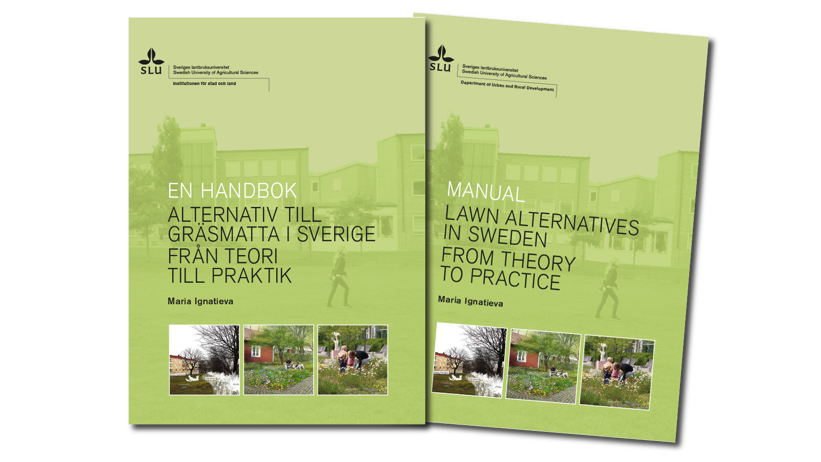
MANUAL Lawn alternatives in Sweden - From theory to practice
ISBN (Electronic) 978-91-85735-39-6
ISBN (Printed) 978-91-85735-40-2
Publications and media outreach
Ignatieva, M. & Hedblom, M. (2019). An alternative urban green carpet, Science, 362(6411), pp. 148-149. » https://www.science.org/doi/full/10.1126/science.aau6974?ijkey=ZsSbHbLadKMrQ&siteid=sci&keytype=ref
Ignatieva, M., Florgård, C. & Lundin, K. (2018). Lawns in Sweden: History and Etymological roots, European parallels and future alternative pathways, Bebyggelsehistorisk tidskrift 75/2018, pp. 26-47.
Tidåker P., Wesström, T. & Kätterer, T. (2017). Energy use and greenhouse gas emissions from turf management of two Swedish golf courses. Urban Forestry and Urban Greening, 21, pp. 80-87.
Ignatieva, M., Eriksson, F., Eriksson, T., Berg P. & Hedblom, M. (2017). Lawn as a social and cultural phenomenon in Sweden. Urban Forestry & Urban Greening, 21, pp. 213-223.
Hedblom, M., Lindberg, F., Vogel, E., Wissman, J. & Ahrné, K. (2017). Estimating urban lawn cover in space and time: Case studies in three Swedish cities. Urban Ecosystems, pp. 1-11.
Poeplau C., Marstorp H., Thored K., Kätterer T. (2016). Effect of grassland cutting frequency on soil carbon storage - A case study on public lawns in three Swedish cities. Soil discussion http://www.soil-discuss.net/soil-2015-78/
Eriksson, F., Eriksson, T. & Ignatieva, M., (2015). Golf courses as part of urban green infrastructure: social aspects of golf courses and extensively managed turfgrass areas from Nordic perspective, Proceedings from 52nd IFLA Congress, June 6-7 2015, St. Petersburg Russia.
Ignatieva, M., Ahrné, K., Wissman, J., Eriksson, T., Tidåker, P., Hedblom, M., Kätterer, T., Marstorp, H., Berg, P., Ericsson, T., Bengtsson, J. (2015). Lawn as a cultural and ecological phenomenon: A conceptual framework for transdiscipilinary research, Urban Forestry & Urban Greening, 14, pp. 383-387.
Wissman, J., Norlin, K. & Kall, A.-S. (2015). Klippa Gräsmattan - självvald skötselmetod? Biodiverse, 1:2015.
Ignatieva, M. (2015). Alternativa grönytor - hur man designar för biologisk mångfald i staden, Biodiverse, 2:2015, p. 20.
Science Podcasts, 11 October 2018
» The Science podcast: What we can learn from a cluster of people with an inherited intellectual disability, and questioning how sustainable green lawns are in dry places
TV 1 Uppsala: http://www.svt.se/nyheter/lokalt/uppsala/de-planterar-alternativ-grasmatta
Radio: https://sverigesradio.se/sida/avsnitt/721690?programid=1667
The project team
PROJECT LEADERS
Maria Ignatieva, Professor, Div. of Landscape Architecture, SLU (-2019)
Karin Ahrné, Environmental Assessment Specialist at the Swedish Species Information Centre SLU
Jörgen Wissman, Researcher, SLU Biodiversity Centre (-2023)
RESEARCHERS
Tuula Eriksson, Researcher, Div. of Landscape Architecture, SLU (-2018)
Jan Bengtsson, Professor, Dept.of Ecology, SLU
Per G Berg, professor, Div. of Landscape Architecture, SLU (-2020)
Pernilla Tidåker, Senior Lecturer, Dept.of Enregy and Technology, SLU
Håkan Marstorp, Researcher, Dept.of Soil and Environment, SLU
Tom Ericsson, Senior Lecturer, Div. of Landscape Architecture, SLU (-2015)
STAKEHOLDERS GROUP
Per Westerlund
Uppsala Municipality
Lars Johansson
SLU, Uppsala
Inger Runeson
Pratensis AB
Tim Delshammar
SLU, Alnarp
Maria Strandberg
STERF
Mats Grönvik
Sundbybergs stad
Ylva Kjellin
Sundbybergs stad
Vilhelm Kroon
Sundbybergs stad
Sofie Wikberg
www.frilansekolog.se
Marit Gamberg
Veg Tech AB
FOCUS GROUP
James Hitchmough, University of Sheffield, UK
Lionel Smith, University of Reading, UK
Katherine Baldock, University of Bristol, UK
Fredrik Eriksson, Uppsala University, Sweden