
Measuring forest photosynthesis and carbon uptake using solar-induced chlorophyll fluorescence (SIF)
Project overview
Participants
More related research
Global goals
- 13. Climate action
Short summary
Forest carbon uptake is crucial for the climate. This project investigates how a faint light emitted by plants during photosynthesis (solar-induced chlorophyll fluorescence, SIF) can be used to measure carbon uptake from satellites and improve estimates of how forests are affected by climate stress.
Photosynthesis forms the basis of forest carbon uptake and plays a central role in the global carbon cycle. Through photosynthesis, trees absorb carbon dioxide from the atmosphere and convert sunlight into chemical energy. Understanding how efficiently forests carry out this process – and how it is affected by environmental stress such as drought – is essential for assessing the role of forests in the climate system.
The project focuses on solar-induced chlorophyll fluorescence (SIF), a faint light signal that arises as a by-product of photosynthesis. The signal can be detected using satellite and airborne remote sensing and has been shown to be closely linked to plant photosynthetic activity. By analysing SIF at the canopy level, the project examines how well the signal reflects carbon assimilation and gross primary productivity (GPP), that is, the total amount of carbon taken up through photosynthesis.
Particular attention is given to how environmental stress influences these processes. During drought or high atmospheric dryness, trees regulate carbon uptake by adjusting their stomatal openings (small pores in the leaves). When stomata close to reduce water loss, carbon uptake decreases, which in turn affects the fluorescence signal emitted by the plants. The project investigates how these physiological responses are reflected in SIF measurements across different timescales and spatial scales.
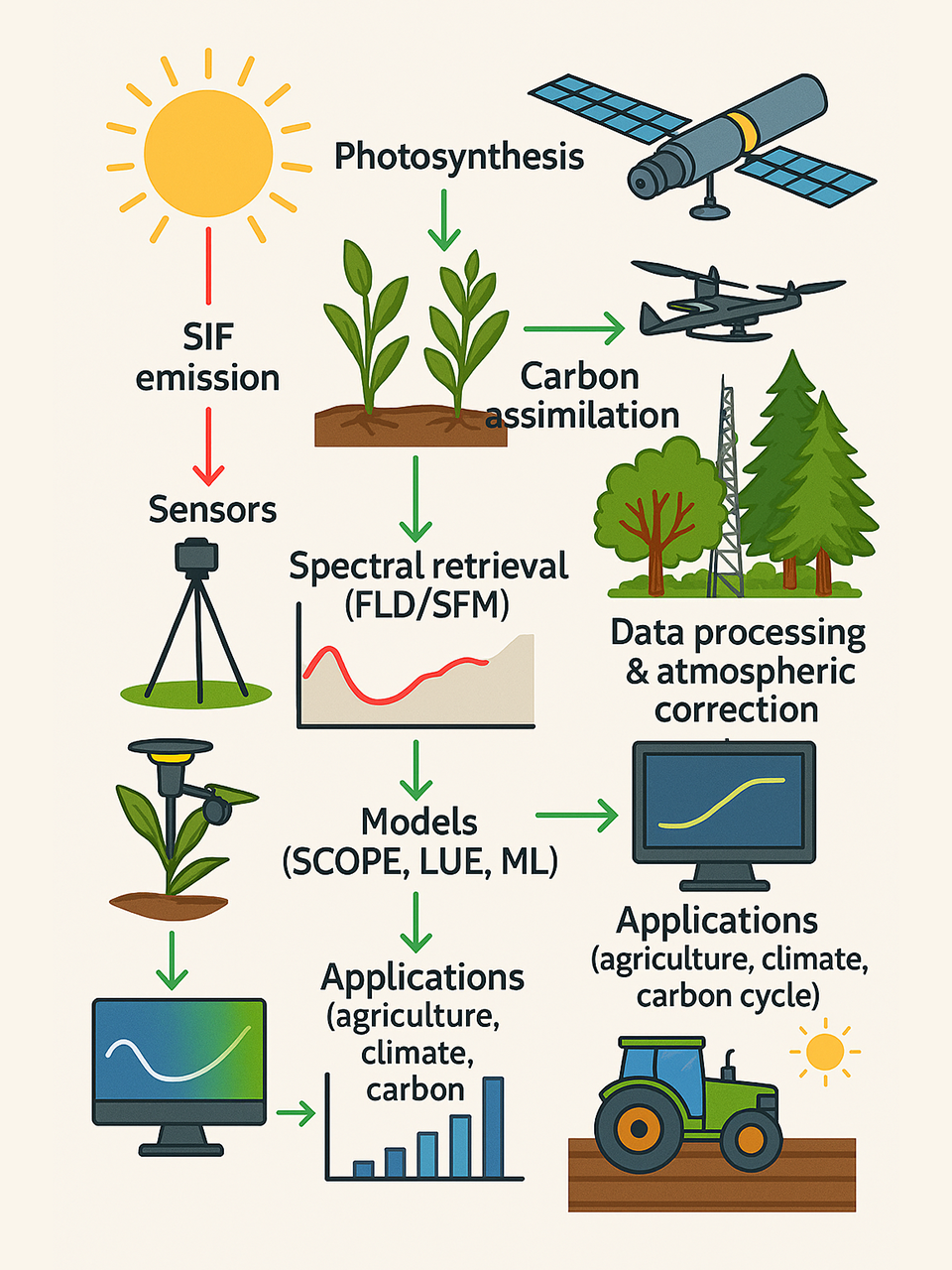
The research combines satellite observations, ground-based measurements and forest growth modelling, including the 3-PG model – an established model for simulating forest growth and carbon fluxes – to improve interpretation of SIF signals. Environmental drivers such as vapour pressure deficit (VPD, a measure of atmospheric dryness) and soil moisture are analysed to understand how they influence photosynthesis and the fluorescence emitted by plants.
A central objective is to develop spatially detailed maps of forest carbon uptake (gross primary productivity) across Europe. These maps can contribute to improved monitoring of forest carbon dynamics and provide more robust information for assessing ecosystem functioning under climate change. The project also includes:
- Development of a Swedish vegetation fluorescence map reflecting photosynthetic activity at the canopy level.
- In-depth analysis of the mechanisms governing carbon assimilation under environmental stress and how this influences the SIF signal across different timescales.
- Integration of the 3-PG model to link photosynthetic parameters and environmental factors, such as vapour pressure deficit (VPD) and soil moisture, to variations in fluorescence.
Research team
PhD student: Ameenat Kehinde Adesina
Main supervisor: Ruben Valbuena
Assistant supervisor: Langning Huo
Project period: November 2025 – November 2029
This project is part of WIFORCE – the Wallenberg Initiative in Forest Research, funded by the Knut and Alice Wallenberg Foundation.