
SAFE Pig – Biosecure and profitable pig production in wild boar-dense areas
Project overview
More related research
- Bioinformatics
- Microbiology
- Genetics and Genomics
- Ecology
- Food Science
- Soil Science
- Animal and Dairy Science
- Medical Bioscience
- Pathobiology
- Clinical Science
- Other Veterinary Science
- Fish and Wildlife Management
- Environmental Sciences and Nature Conservation
- Molecular Biology
- Public Health, Global Health and Social Medicine
- Applied Psychology
Global goals
- 1. No poverty
- 2. Zero hunger
- 3. Good health and well-being
- 6. Clean water and sanitation
- 8. Decent work and economic growth
- 9. Industry, innovation and infrastructure
- 12. Responsible consumption and production
- 15. Life on land
Short summary
This project aims to safeguard the future of Swedish pig production by identifying key infection risks and developing robust, farm adapted biosecurity strategies.
The focus is on reducing disease transmission between wild boar, domestic pigs, and the environment, with particular attention to high impact pathogens such as African swine fever (ASF) and Salmonella.
Objectives
- Map the occurrence of priority pathogens in wild boar, domestic pigs, and surrounding environments.
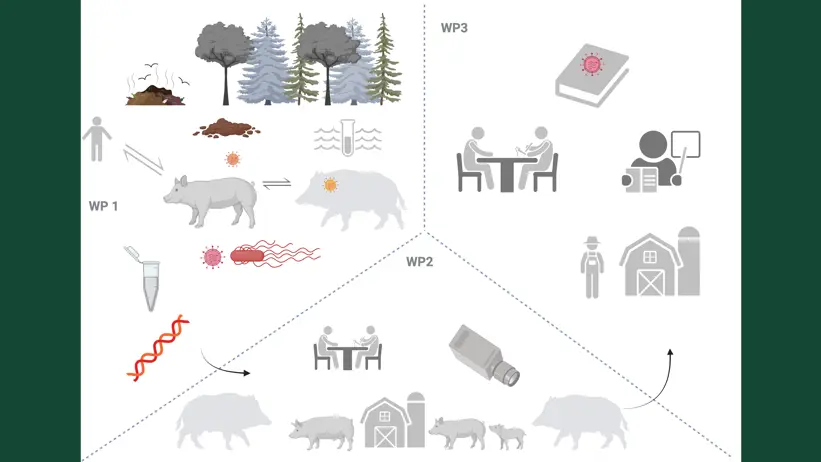
- Identify contact areas where direct and in-direct transmission is likely to occur.
- Refine the existing national biosecurity programme to provide risk‑based, farm‑specific recommendations based on identified contact areas, thereby reducing pathogen transmission to, from, and between wild boar and domestic pigs.
As domestic pigs and wild boar share pathogen spectrum, and transmission between them has been documented in Sweden (Stenberg et al., 2021, Ernholm et al., 2022), the growing wild boar population poses a threat to Swedish pig production. The outbreak of African swine fever (ASF) in Fagersta 2023 further underscores the urgent need for improved preparedness and a deeper understanding of disease transmission. In both indoor and outdoor farming systems, there is a risk of indirect but also direct contact between wild boar and domestic pigs, particularly in outdoor farming systems.
The project will target important pathogens including Salmonella Choleraesuis, Lawsonia intracellularis, Brachyspira hyodysenteriae, atypical porcine pestivirus (APPV), ASF virus, influenza, hepatitis E genotype 3, Actinobacillus pleuropneumoniae (APP), and porcine circovirus type 2 (PCV2). By combining field sampling with advanced molecular methods such as Hyperplex PCR, we will generate a comprehensive picture of direct and indirect transmission routes, including environmentally mediated pathways such as manure‑contaminated fields.
Expected results and benefits of the project
This project challenges the traditional one‑way view of transmission from wild boar to domestic pigs by also investigating spillback from domestic pigs to wild boar. Such spillback may lead to pathogen amplification in wild boar populations before re-entering domestic herds.
Expected outcomes include:
- Evidence‑based identification of high‑risk contact areas.
- Enhanced, risk‑based biosecurity guidelines for both indoor and outdoor pig production systems.
- Reduced disease risk, improved animal welfare, and increased economic resilience in Swedish pig production.
In the long term, the project will deliver practical, cost‑effective biosecurity solutions tailored to farm‑specific risks, ensuring sustainable pig production even under future disease threats.
Overall, this project has the potential to not only enhance scientific understanding of pathogen dynamics in pig farming but also to influence policy and biosecurity programs on a national and possibly international scale. By combining interdisciplinary expertise, innovative technologies, and a focus on real-world application, the project seeks to contribute significantly to the sustainability and resilience of Sweden’s pig production, while also addressing broader global challenges related to disease control, food security, and animal welfare.
Project group
Co-applicants
- Hedvig Stenberg, SVA
- Erika Chenais, SVA
- Marie Sjölund, SVA
- Johanna Fjelkner, Gård & Djurhälsan
- Anna Székely, SLU
- Jessica Ekström, LRF Kött
Reference group
- Ellinor Spörndly-Nees, SVA
- Johan Eriksson, Sveriges Grisföretagare
- Axel Sannö, SLU och Gård & Djurhälsan
- Linda Ernholm, SVA
- Stefan Widgren, SVA