Explore the key role of forests in a sustainable bioeconomy and become an expert in the forest industry’s sustainability potential.
Gain in-depth knowledge of the entire forest value chain – from raw biomaterials to finished products – with a focus on circular processes and sustainable development.
Develop your leadership and innovation skills to drive sustainable business models in the forest industry.
Registration deadline: 15 January 2026
Course start date: 31 August 2026
Course scope: 2 years, 120 credits
Study location: Uppsala
Do you want to explore the forest's key role in a sustainable bioeconomy? Gain expert knowledge about the forest industry and its sustainability potential. The master's programme in forest bioeconomy opens doors to careers in forestry, consulting, and more.
Programme information
This Master's programme is designed for students with a background in social or natural sciences who wish to explore the role of forests in advancing a circular bioeconomy. In this programme, you will examine the entire forestry value chain—from timber to finished products – and learn how it contributes to sustainable development.
Throughout the programme, you will gain an in-depth understanding of the forest sector and the bioeconomy, including products, processes, and systems. Combined with studies in business, economics, and sustainability, this unique combination of social and natural sciences, positions you well to shape society’s future and succeed in the job market.
The programme is based at the Uppsala campus. You will have the opportunity to take courses with students from other programmes, enabling you to network, exchange ideas, and gain insights from diverse sectors.
You may apply, on a competitive basis, to the TRANSFOR-M exchange program for your second year of program studies. Within TRANSFOR-M, you will study for a year at one of three partner universities: University of British Columbia, University of Alberta or Lakehead University. Upon completion, you will meet the requirements to apply for a double degree—one from SLU and one from the Canadian partner university.
Facts and requirements
Name:Forest Bioeconomy (MSc)
Level:Master
Language:English
Programme scope:2.0 year , 120.0 credits
Next start:HT 2026
Tuition Fees:Citizens of countries outside the EU/EEA and Switzerland are required to pay application and tuition fees.
First semester:72000
Total:SEK 288000
Application deadline for international students:2026-01-15
Application deadline for Swedish students:2026-04-15
Study location:Uppsala
Pace of study:Full-time
Teaching form:On-campus
Application code for Swedish students:81176
Application code for international students:81177
Requirements:
To be admitted to the Master’s programme Forest Bioeconomy, the following criteria must be met:
general entry requirements: first-cycle (Bachelor’s) qualification comprising a minimum 180 credits or equivalent degree from a higher education institution abroad;
specific entry requirements: a minimum of 60 credits from specialist study within one of the following subjects or main fields of study:
Forestry Science
Forest Science
Forest Management
Agricultural Science
30 credits in Economics and Business Administration, including at least 15 credits in Business Administration
In addition, knowledge equivalent to the Swedish upper secondary course English 6 is required. This requirement is met by those holding a Degree of Bachelor (180 credits) from a Swedish higher education institution. There are specific rules for applicants from certain English-speaking countries.
The specific entry requirements stated above can also be met by someone who has obtained equivalent knowledge through a corresponding qualification from abroad, or in some other way.
There are specific entry requirements for each course included in the programme. These are described in the relevant course syllabus.
Degree:
Degree awarded upon completion of the programme
The Master’s (120 credits) programme Forest Bioeconomy leads to a Degree of Master of Science (M.Sc) with a major in Bioeconomy Management. A Degree of Master is a general qualification.
Students who fulfil the qualification requirements for a Degree of Master (120 credits) in the main field of study will be issued a degree certificate on request. The degree certificate will specify the qualification as Degree of Master of Science (120 credits) with a major in Bioeconomy Management.
Other qualifications may be awarded provided that the requirements for them are fulfilled (see the SLU local System of Qualifications).
The programme contains courses which, depending on choice of courses and combination with previous studies in forestry at first-cycle level, may enable students to fulfil the requirements for the professional qualification Degree of Master of Science in Forestry, 300 credits. The outcomes for a Degree of Master of Science in Forestry are stipulated in the Ordinance for the Swedish University of Agricultural Sciences. The requirements for a Degree of Master of Science in Forestry are defined in SLU’s system of qualifications.
Degree requirements
A Degree of Master of Science (M.Sc.) with a major in Bioeconomy Management is awarded to students who have successfully completed 120 credits, of which at least 90 credits are from second-cycle courses, from the required courses as follows:
a minimum of 30 credits from courses with specialised study in Bioeconomy Management (A1N, A1F)
a minimum of 30 credits from a degree project in Bioeconomy Management (A2E).
Additionally, students must have successfully completed a Degree of Bachelor, a professional qualification comprising a minimum of 180 credits, or have an equivalent qualification from abroad.
The Degree of Master of Science (120 credits) may contain a maximum of 30 credits from first-cycle courses, provided these credits were not included in a Degree of Bachelor or its equivalent. All courses included in a degree must be at university level, have been successfully completed and may not overlap/have similar content.
Admission: There are two admission rounds for this Master's programme. The first admission round is open to all international applicants at www.universityadmissions.se. SLU strongly encourage all international students to apply in this first admission round.
Content
During this Master's programme, you will receive training in bioeconomy management, building on your previous studies in business and bioeconomy-related subjects. You will learn to initiate, organise, and lead processes aimed at implementing and advancing sustainability, circularity, and the bioeconomy.
In the first year, you will acquire in-depth knowledge of the global forest sector, business studies (including marketing and value chains), and macroeconomics (markets and market functions). You will also explore wood properties and its innovation potential.
In the second year, you will deepen your expertise in innovation management, forest policy, and research methods. For your Master's thesis, you will have the opportunity to specialise in a chosen topic by applying your knowledge, skills, and analytical approach within the field of Bioeconomy Management. While studying at SLU, you may choose courses outside the planned programme, either at SLU or at other Swedish universities. There are also excellent opportunities for exchange studies at one of SLU's partner universities worldwide.
Welcome to SLU Campus Uppsala
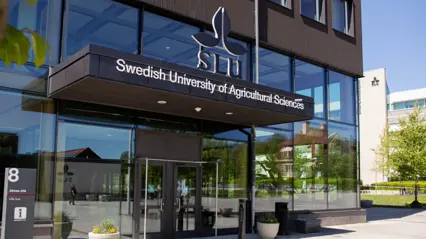
Uppsala, Sweden's fourth-largest city, serves as the hub of SLU's educational activities. Situated just outside the city center, SLU's Uppsala campus offers a spacious, leafy, and picturesque environment. It is a fitting setting for Sweden's only agricultural university and possibly the most research-intensive university. With two universities in Uppsala, students can immerse themselves in a lively, dynamic, and stimulating atmosphere.
Career
Combining forestry expertise with knowledge in bioeconomy, especially focusing on sustainability and circularity, opens up numerous job opportunities. These job opportunities can be found in various sectors such as consulting firms, forest-based industrial companies, banks and insurance companies, government authorities, interest groups, and certification companies. Furthermore, this programme equips you with the necessary skills for further studies in economic subjects.
The programme includes courses that can be used as the foundation for fulfilling the requirements for the professional forester's degree, depending on the courses you choose and your previous studies at the bachelor's level.
Degree awarded
A Degree of Master of Science with a major in Bioeconomy Management.
Studying at SLU is not just about attending lectures and seminars. It’s also about newfound friends, sports, fun parties, and exciting experiences. It’s about creating memories that will last a lifetime.
Connect with our international student ambassadors and explore their blogs for a firsthand glimpse into their journeys as students in Sweden and at SLU.
Who has to pay application and tuition fees? What is the cost of living in Sweden? Read more about these and other questions regarding tuition fees and scholarships.
Are you on your way to Sweden and wondering what it’s like to study here? Well, get ready to question the way things have always been done. Studying in Sweden comes with critical thinking, freedom and responsibility.