Research
We develop ecological theories in order to understand how the world works. Our research is used within wildlife management, nature conservation, forestry and agriculture.
SLU Grimsö Wildlife Research Station
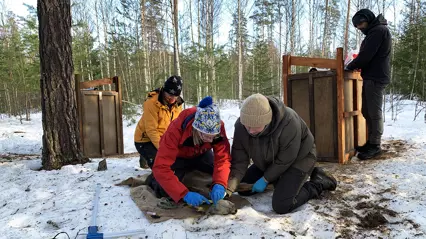
All year round, researchers and field staff at the SLU Grimsö Research Station work with monitoring, research and teaching och about wild animals.
International setting
We have doctoral students and researchers from around the globe. Our employees conduct field studies in places such as Greenland, Mongolia, Brazil and Rwanda. We collaborate with researchers from the entire world.
About us
Here you will find contact information and an overview of the department's work in research, environmental analysis, teaching, and collaboration.
News & Events
News
-
Swedish flower-strip initiative boosts pollinators - with variable effects in crops
Flowering field margins have become an increasingly common feature in the Swedish agricultural landscape. A new study from SLU shows that they work well to attract pollinators, but that their effects on pests and beneficial organisms in crops are more nuanced than previously thought. -
Close ties between tourism and science in Svalbard
Science and tourism in Svalbard are often seen as two separate worlds. However, they have developed together and continue to be closely interconnected. This is shown by researchers at the Swedish University of Agricultural Sciences (SLU). -
She wants to find out how forest management affects nature’s own defences
What impact does human activity, such as forest management, have on the natural control of insect pests? Fredrika Wrethling, a PhD student at the SLU Forest Damage Centre’s research school, has been looking into this in the first part of her project. -
Help SLU find wild honey bee colonies this summer
Do wild honey bee colonies still exist in Sweden and Europe? And if so, how do they manage to survive alongside the dreaded Varroa mite? These are questions that researchers at the Swedish University of Agricultural Sciences (SLU) aim to answer – with the help of citizen scientists and beekeepers. -
Growing a broad set of crops does not threaten food security – quite the opposite
Crop rotations with a broad set of crops can produce more calories and nutrients than growing only cereals year after year. This result of an international study led by the Swedish University of Agricultural Sciences (SLU) challenges the common argument that diverse crop rotations produce less food.
Calendar
Research
Research projects
-
Microclimate buffering and species responses to clearcut and non-clearcut forestry
How do changes in microclimate affect forest biodiversity? This project investigates how different forest management practices, such as clear-cutting and continuous-cover forestry, influence microclimate and, in turn, the survival and vitality of different species. -
The function of tree retention for biodiversity
How do trees retained after harvesting affect biodiversity over time? This project investigates how retention trees contribute to preserving species in managed forests, with a focus on lichens growing on aspen. -
Microclimate and roadside plants (MicRoad)
We are investigating interactions between microclimate and roadside plant communities across Sweden.
Research groups
-
SKANDULV
The border between Sweden and Norway cuts through the wolf's core territory in Scandinavia. The Scandinavian wolf research project SKANDULV coordinates research on wolf ecology. -
Insect ecology - Ecology and Society
We are in the midst of a biodiversity crisis. To grasp the extent of what is happening, we need to understand the forces creating variation in organism diversity and numbers, how organisms interact with each other (including humans), and the repercussions in terms of ecosystem functioning. -
Biodiversity and biocontrol lab
We perform research on biodiversity and ecosystem services in agricultural landscapes. We study the links between biodiversity, food-web structure and service provisioning, and how farming practices and land use at different scales can be modified to support ecosystem services.