
Child-Friendly Everywhere! But What Does That Really Mean?
Child-friendly environments are about more than playgrounds and schoolyards. Children are affected by society as a whole, including places that are rarely planned with them in mind. Child-Friendly Everywhere! was the theme when the BUB and ARKiS networks gathered in Stockholm on 16 October.
How can we create environments where children's rights, needs and perspectives are naturally taken into account? When we think about child-friendly environments, playgrounds, schoolyards, residential courtyards and parks often come to mind. But children do not live their lives exclusively in places specifically designed for them. They move through streets and squares, visit hospitals and public buildings, and sometimes encounter environments associated with grief and difficult life situations.
How child-friendly is our society beyond the places we traditionally consider to belong to children?
With the theme Child-Friendly Everywhere!, this year's joint network meeting of BUB (Children, Young People and the Built Environment) and ARKiS, Architects Sweden's network for architecture and children, aimed to broaden the conversation about children's place in the built environment. Over the course of a full day in Stockholm, researchers, architects, planners, students and others came together to share experiences, discuss challenges and explore how child-friendly environments can be created in practice.
From Good Intentions to Reality
One of the recurring questions throughout the day was what it actually takes to create child-friendly environments everywhere. The UN Convention on the Rights of the Child has been incorporated into Swedish law since 2020, and there is extensive research, practical experience and a range of methods available to guide this work. Why, then, is it still so difficult to put this knowledge into practice?
The discussions highlighted that child-friendliness needs to be understood from several perspectives. Children's own experiences are valuable, but equally important is adults' responsibility to draw on existing knowledge and make decisions that take children's diverse needs and circumstances into account. Participatory processes can play an important role in promoting inclusion and ensuring high-quality outcomes. Children and young people are not a homogeneous group. Their experiences, circumstances and needs may therefore vary across different groups and places. However, involving children does not automatically mean giving them influence, and such processes need to be carefully designed with attention to their specific context.
Another important consideration is that children are not simply recipients of environments planned by adults. They actively use, interpret and shape places through play, movement and social relationships. Creating environments that allow children to act independently, explore and influence their surroundings in everyday life is therefore also a way of strengthening their agency, without necessarily relying on organised participatory processes.
Perhaps the overarching question, then, is not which perspective matters most, but how we can bring together children's experiences, adults' responsibilities and existing knowledge to create more child-friendly environments. This requires us to consider which children and young people we have in mind, since their needs, opportunities and living conditions can differ considerably. It also requires us to take a broader view of all the environments that affect children and explore how these can become more child-friendly.
This year's network meeting did not provide simple answers, but it offered many concrete examples, new perspectives and important conversations to carry forward.
Child-Friendly Everywhere is about recognising that children are already part of society as a whole, and that their perspectives and rights need to matter, including in places that were not primarily designed for them.
Presentations Throughout the Day
Study Visit to Fryshuset
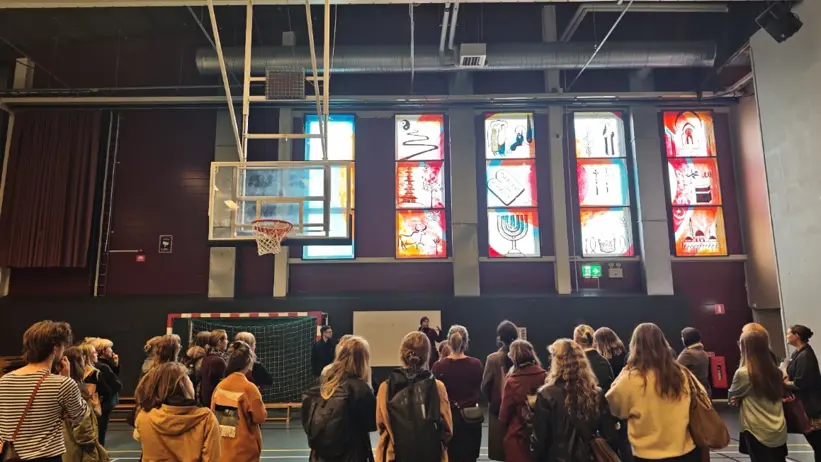
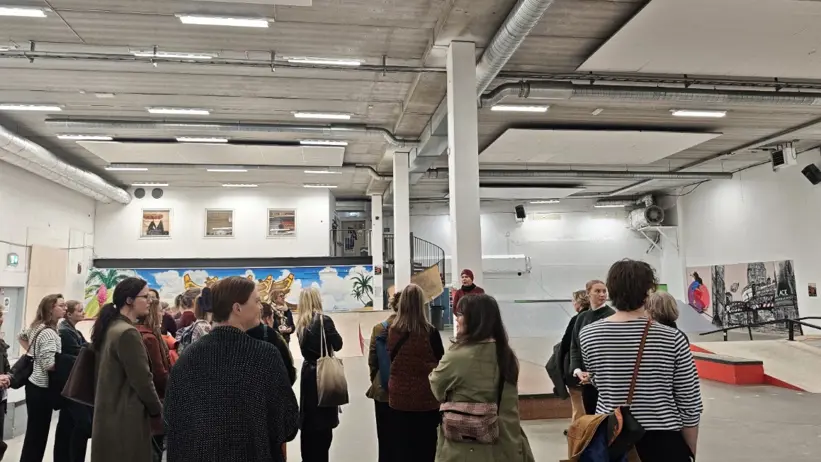
The day began with a study visit to Fryshuset in Hammarby Sjöstad, where Susanne Svensson, Director of Fryshuset Stockholm, together with other staff members, described the organisation's work to create opportunities for young people to develop, engage and influence their own lives. Fryshuset runs around 60 activities and programmes across Sweden in areas including youth culture, sports, education, social work and entrepreneurship, taking young people's interests, needs and engagement as its starting point. During the visit, we also gained insight into the wide range of activities offered, from basketball, skateboarding and dance to music, concerts and other cultural and social activities.
The visit also provided an insight into the development of Fryshuset's campus, where new buildings are planned to create further opportunities for the organisation to expand. Staff explained that outdoor environments had not received much attention in their work so far, while also expressing an openness to developing this aspect.
The visit prompted an important reflection ahead of the day's discussions: a child-friendly environment is not only about the physical design of a place, but also about what happens there, the relationships that can develop, and the opportunities children and young people have to participate and exert influence. Although Fryshuset is an organisation specifically aimed at young people, its work reminds us of the importance of giving young people a recognised place in society, where they are not merely visitors or recipients of services, but active participants with their own ideas, interests and abilities.
This connection between the physical and social environment, as well as between adults' responsibilities and children's opportunities to exert influence, was a recurring theme in several of the afternoon's presentations.
Healthcare Environments, Streets and Safety
A recurring question throughout the day concerned the distinction between an adult perspective on children, children's own perspectives and a children's rights perspective. These concepts are often used together, but they mean different things. Creating good environments for children involves both drawing on adults' knowledge of children's needs and understanding when and how children's own experiences can contribute to better decisions.
This became clear in Cristiana Caira's presentation on how children's rights and participation can be integrated into the design of healthcare environments. Caira, Professor at the Centre for Healthcare Architecture (CVA) at Chalmers University of Technology and Partner at White Arkitekter, presented insights from an upcoming report, A Children's Rights Perspective in the Design of Healthcare Environments. A webinar is planned in connection with the report's publication.
The report's examples from children's hospitals in Gothenburg and Cambridge illustrate different approaches and perspectives. In the renovation and extension of Queen Silvia Children's Hospital in Gothenburg, there was a clear ambition to create a welcoming, playful and safe environment for children and young people. In the planned Cambridge Children's Hospital in the United Kingdom, children's participation has instead been integrated into the project's organisation from the very beginning. Children were even involved in selecting the architects by interviewing the different teams and evaluating their proposals!
Liza Olander Wihlney and Sara Stiber from Växtvärket shared their experiences of developing street environments that promote children's freedom of movement and opportunities for play. The Gatulabba project has generated proposals such as "play networks" consisting of streets with limited or no motor traffic, where children can move around in playful ways. Although these ideas have been considered radical, they demonstrate the need for new ways of thinking about how to create child-friendly environments. Gatulabba has also been largely based on children's participation and has resulted in a collection of methods for involving children.
In many environments, children and young people's freedom of movement is restricted by feelings of insecurity. One way to address this is through co-created lighting design, an approach used by lighting designer Kajsa Sperling at White. She presented how young girls had participated in developing outdoor lighting solutions, including the Hjällbolyktan streetlight. The presentation showed how both the participatory process and the resulting lighting, designed to promote a sense of safety, had positive outcomes for young people in Hjällbo.
These presentations raised a question that extends far beyond healthcare environments: How can children's participation become meaningful, and when can their involvement make a real difference?
The Difficult Places
What does child-friendliness mean in places associated with grief, anxiety or other difficult life situations? This question became particularly relevant through two presentations that drew attention to environments where children's needs and perspectives can easily be overlooked.
Jenna Gillinger, artist and doctoral student at Konstfack University of Arts, Crafts and Design, presented her work A Fair and Honest Trial, in which she has explored how the architecture and interior design of Swedish courts can affect people in psychologically vulnerable situations. Among the issues she highlighted was the use of shared waiting rooms, where complainants, witnesses and defendants may have to remain in close proximity to one another. For people who have already experienced trauma, the physical environment can contribute to further stress and insecurity. Her presentation raised questions about how architecture could instead reduce vulnerability and create a greater sense of safety, particularly for children.
Katarina Pelinska, Landscape Architect at AFRY, broadened the discussion further through her presentation Swinging Away the Sorrow. Drawing on examples ranging from urban environments and hospitals to cemeteries, she illustrated how playfulness, sensory experiences and opportunities for exploration can be integrated even into places that are not primarily designed for children. Among the examples was St Erik's Church and its ash burial ground in Sollentuna, where a swing overlooking the landscape demonstrates how a place associated with grief can also become child-friendly while serving several different functions.
Together, the presentations demonstrated that child-friendliness does not necessarily mean changing a place's primary function or turning it into a playground. Rather, it is about recognising how children experience and use different environments and making room for their needs, even in contexts traditionally designed from an adult perspective. Perhaps it is precisely in places such as courts and cemeteries that the ambition of creating child-friendly environments everywhere becomes most interesting.
This year's network meeting was organised by BUB and ARKiS, with funding from SLU Movium and support from LINK Arkitektur. Read more about the network meeting and its programme.
Contact
-
PersonAmanda Gabriel, LecturerDepartment of People and Society