
Allergic disease in horses - characterization of immune cells to improve treatment options
Allergic diseases such as asthma, allergies, and eczema affect many horses every year—some so severe that the horses must be euthanized. Treatment options are currently limited. Researchers are now investigating furher, hoping to make discoveries that can lay the groundwork for future treatments.
The body’s immune system is designed to protect against threats. But when it is triggered in response to everyday substances such as pollen, harmless insect bites, and various foods, the immune system that is meant to protect us instead becomes a problem. What is supposed to help actually does more harm than good.
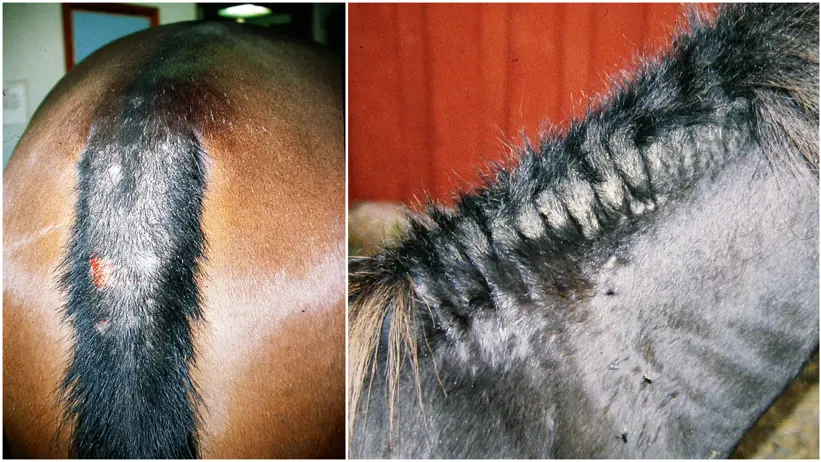
Allergies are also common in horses and can manifest themselves in the form of both summer eczema—in which the horse often scratches until the skin breaks, bleeds, and is at risk of infection—and asthma, which in its most severe form can cause chronic inflammation of the airways, coughing, and severe breathing difficulties.
Allergies in horses thus lead to both reduced performance and a lower quality of life. But that’s not all; in some horses, the symptoms become so severe that the only option is euthanasia.
A research team with cutting-edge expertise
With 3 million SEK at her disposal, researcher Sara Wernersson has assembled a research team ready to take on the challenge: to understand the disease processes in horses with allergies, in order to better treat them in the future. The team brings together expertise in immunology, veterinary medicine, and biology at the cellular and molecular levels—from the horse’s body as a whole down to its smallest components.
And to achieve this, there is a plan in which researchers delve not only into the details—but down to the cellular level.
Mast Cells: A key clue in allergic diseases
Mast cells are part of the immune system; they are immune cells found in the skin, mucous membranes (such as the lungs), and the gastrointestinal tract. They protect the body against foreign substances and infections, constantly ready to react to substances that could be harmful to the body—even if this reaction is entirely unnecessary, as in the case of allergies.
When these cells come into contact with a substance to which the body reacts—whether it is a genuinely dangerous infectious agent or a harmless allergen—they may, in some cases, release a substance called histamine. This causes the body’s blood vessels to dilate and the mucous membranes to swell, which can result in both a rash and difficulty breathing: allergic symptoms.
Previous studies have indicated that mast cells, in particular, play an important role in allergic diseases—not only by releasing histamine and causing inflammation, but also by influencing the harmful reaction in a more fundamental way. However, how mast cells function in horses and what role they play specifically in equine allergic diseases has not yet been fully elucidated.
The goal: To identify changes in the horse's body caused by summer eczema.
The project has been carefully planned to ensure the best possible results and consists of three key components:
- Step 1: To assess how the immune system reacts in horses with and without summer eczema, both during the season (late summer) and outside the season (in winter), using small skin samples—known as biopsies—taken from the horse’s skin
- Step 2: Examine the specific mast cells that are often involved in allergic diseases to determine how they are expressed and what role they play in horses specifically
- Step 3: Involves using test tubes and a microscope to study how mast cells react when they come into contact with stimulants and allergens. All of this is done to try to understand the disease processes involved in allergic diseases in horses.
“The ideal scenario would be to pave the way for future cures”
Since the study began in January 2024, work has been in full swing, both in collecting biopsies from horses and in conducting the initial analyses.
The goal is ambitious: to contribute to future treatment methods for caring for and saving affected horses.
Support research at SLU
Facts about the project:
- The research project is funded by Formas with 2,998,803 SEK.
- It was launched in early 2024 and is expected to continue through the end of 2026 and into 2027.
- The project is led by researcher Sara Wernersson, an associate professor in the field of inflammation at the Swedish University of Agricultural Sciences (SLU), and a research team consisting of:
- Miia Riihimäki, a licensed veterinarian with a Ph.D. in equine asthma from SLU.
- Amanda Raine, researcher at Uppsala University (UU) and SciLifeLab.
- Lars Hellman, professor of molecular and comparative immunology at UU.
- Srinivas Akula, researcher at SLU
The project is planned to be carried out in three sections, which can be simply described as:
-
A study of how the immune system responds in horses with summer eczema by examining the types of cells present in both affected and healthy horses, as well as how these cells express themselves. A group of horses affected by summer eczema is compared both during the summer eczema season (around September), when the immune system is expected to be activated, and during the winter, when the disease is not active.
-
A study of mast cells in horses from various (healthy) tissues that may be affected by allergic diseases (healthy skin, healthy lungs, and healthy intestines), in order to characterize and describe the mast cells in these different tissues and their respective functions. The aim is to better understand the function of mast cells in the horse’s body; this information can then be compared with existing knowledge about mast cells and their role in the bodies of mice, humans, and now also horses. Biopsies will be collected from slaughtered horses.
- A test-tube study (in vitro) in which stimulants and allergens, respectively, are added to purified mast cells to study how they react. This study is a follow-up to a previously conducted asthma study on mast cells.

Read more interviews with researchers
Contact
-
PersonSara Wernersson, Senior LecturerHBIO, Anatomy and Physiology