
Improving Reproduction Using New Sequencing Technologies - Can it Provide the Food Fish of the Future
Rainbow trout and char: Swedish fish species currently too scarce to meet the growing needs of the population. Therefore, opportunities to improve the reproduction of what could become the food fish of the future are now being investigated. Join us in exploring the world of Swedish fish farming!
Inside a Swedish fish farm
Imagine walking through the gates and being greeted by the following sight:
Fish tanks are of different sizes and shapes with different purposes: nursery, separated male and female fish, young and fully grown, and large fish. To the right is a huge oxygen tank; outside are ponds where fish grow bigger.
In a large fish farm, such as the Swedish VBCN, there are roughly 375,000 fish, ranging from larvae to 9-year-old adults of species like Arctic charr, rainbow trout, and brown trout. In such a large fish farm, the annual production can reach up to 30 tons of fish.
Many people also work diligently within the facility to maintain the fish's living environment and secure future generations. They monitor the oxygen level, temperature, and nutrient content in the water tanks. They collect roe from the females and milt from the males — and, after careful calculations, ensure that the right eggs and sperm are mixed to produce the next generation of fish.
But why go to all this trouble when fish can be naturally caught from our large lakes and seas? The answer is to be able to control breeding and select the best individuals with desirable traits using tools like selective breeding and AI.
The VBCN Research Station
Today, Arctic charr is a rare commodity in the food market. It is classified as a high-quality Swedish food fish that could be an important part of the Swedish diet. However, not today — its fertility is too low.
Arctic charr kept within aquaculture and fish farms tend to exhibit lower sperm quality than their wild counterparts, resulting in a reduced number of fertilized eggs and hatched embryos.
Since the late 1980s, Arctic charr has been the subject of a national breeding program and is still considered a key species in the Swedish aquaculture industry. However, the factors affecting sperm quality have not been investigated until today.
Over the next four years, the VBCN research station and a research group, which Khrystyna Kurta is a part of, are collaborating towards a common goal: to investigate the possibilities of improving reproduction in what could become the food fish of the future.
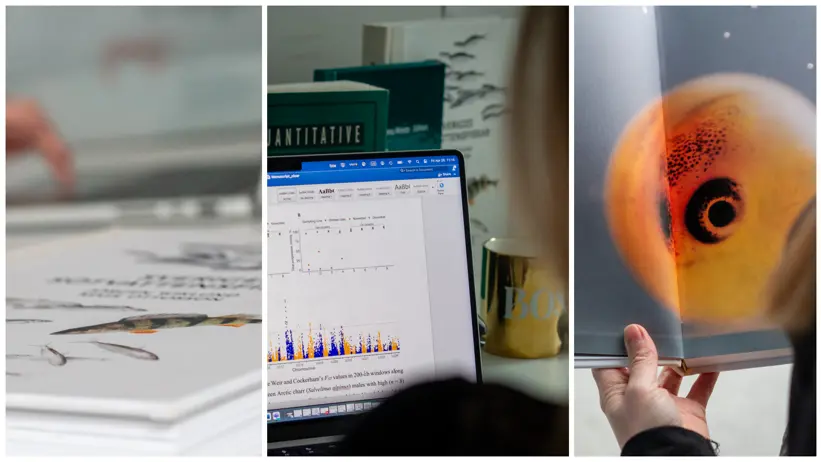
AI, selective breeding, and new genetic methods
Khrystyna Kurta describes her job as "using multiple methods to identify the most fertile fish and ensuring that they are retained in breeding programs." How is this done? The answer is AI and selective breeding.
So, it's about not allowing natural spawning (mating) to occur. Instead, gametes are collected from females and males — and fertilization is done artificially.
However, to form the next generation effectively, eggs and sperm must be carefully selected, which requires much knowledge about which traits should be prioritized.
The Big Question: Production versus Reproduction
The process of AI and selective breeding is well-established within fish farms. In this process, females and males are examined so that the most suitable ones are used for breeding. Notably, the assessment includes evaluating how "good" the fish are from a production perspective. However, measuring the fertility of fish is not currently on the agenda.
The researchers will evaluate Swedish-farmed Arctic charr males based on several parameters, such as age, genetics, and whether it matters when, during the fish spawning season, the sperm is collected. In addition, the research team is questioning whether sperm quality affects the offspring.
Samples are collected and placed under a microscope to conduct these investigations. But there's a catch: the measurement must be quick. The researchers have only a 30-second window to study the sperm before they die. However, with the right techniques, that time is sufficient to extract all the information Khrystyna Kurta seeks.
Indeed, that might be all that's needed to advance the research.
To find 'the fertile gene'
The fish's sperm is assessed through advanced techniques using computers and microscopes, which classify them into one of the following groups:
- Fast
- Medium
- Slow
- or Dead
To avoid retaining infertile males in breeding stock and eliminate the need to test sperm quality in fish multiple times per season, per fish, the researchers have another plan: to search for the trait of "high fertility" in the fish genetic code.
In this way, we can instead take a simple sample from each fish, even at a young age, and determine if it's a fish that should be kept for breeding or not. If our research shows that low fertility is passed on and affects the development and fertility of the next generation, this becomes an important tool for securing the future of farmed fish," she says.
But first, hard work needs to be done to investigate what affects the fertility of Arctic charr males and whether this impacts the development and fertility of their offspring.
The future of a growing population
The demand for nutritious food is increasing as the human population grows. Today, Swedish Arctic charr is a nutritious but expensive food fish that few can afford. However, this may not be the case in the future, especially considering projects like Khrystyna Kurta's work, which improves the prospects for what could become the food fish of the future.
If it becomes possible to identify the genetic code behind high fertility, the results could be transferable to other species, both fish and larger production animals.

Facts about this project:
- Funded with 3,999,996 by the National Research Council Formas
- Expected to last for four years, from 2024 to 2027
- Conducted by researcher Khrystyna Kurta, Swedish University of Agricultural Sciences (SLU) at the forefront along with a team consisting of:
- Christos Palaiokostas, researcher and associate professor in aquaculture with a focus on selective breeding at SLU.
- Simone Immler, professor in genetics and reproduction at the University of East Anglia, Research Park, Norwich, UK.
- Henrik Jeuthe, CEO and research leader at Vattenbruksventrum Norr AB.
The research project is planned to be conducted in three different parts, simply described as:
- Investigate the seasonal and age effects on sperm quality in Arctic charR. The same individuals will be examined over several years and during different parts of the season to see if and how these two factors matter—both for individual fish and as a population.
- Investigate potential genomic influences linked to sperm quality, meaning how certain parts of the fish's DNA code are linked to sperm quality. An experiment that will involve over 600 fish.
- Investigate whether, and if so, how, low sperm quality affects the offspring of the fish. Fish eggs will be inseminated with sperm of varying quality, and embryos from high and low sperm quality will then be compared at different stages to examine which genes act in sperm of low and high quality and also in their respective offspring.
Contact
-
Person