Macronutrients
Here, macronutrients refer to the most commonly occurring chemical elements in the soil.
About macronutrients
By clicking on the elements listed below, you can access maps of Sweden showing the mean concentrations (in weight %) of each macronutrient in forest land mineral soil at a depth of 50 cm. Sampling of the total 1,892 samples was carried out during the period 1983–1987.
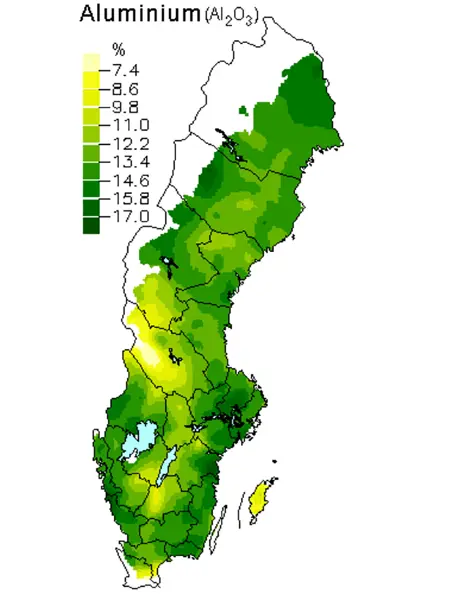
The map below shows the mean concentrations (in weight %) of aluminium oxide (Al₂O₃) in forest land mineral soil at a depth of 50 cm.
Aluminium is a silvery-white metal that readily becomes covered by an oxide film, a so‑called passive layer, which protects it from further attack. It is therefore relatively stable in air and water. Aluminium is the third most abundant chemical element in the Earth’s crust, counting oxygen as the most abundant. Aluminium never occurs in a free state in nature, but is found in compounds mainly with silicon and oxygen, as well as in various combinations with alkali and alkaline earth metals. The average aluminium content of rocks in the Earth’s crust is 8.1%.
In Swedish bedrock and soil types, aluminium occurs mainly as rock-forming minerals and to some extent as secondary minerals formed through weathering processes.
The mean concentration of Al₂O₃ in the 1,892 samples from mineral soil at a depth of 50 cm was 12.6%.
It is worth noting that the minerals in Swedish clays largely consist of various aluminium silicates. The aluminium content of the clay fraction (material <0.002 mm in particle size) may reach up to 20 weight % Al₂O₃.
Read more about the chemical element aluminium on Wikipedia.
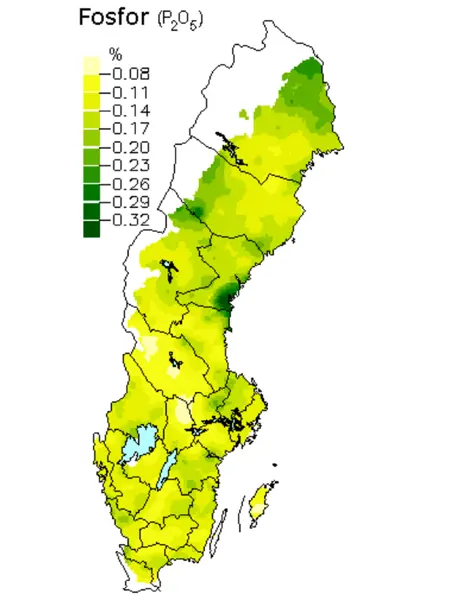
The map below shows the mean concentrations (in weight %) of phosphorus oxide (P₂O₅) in forest land mineral soil at a depth of 50 cm.
Phosphorus is the 11th most abundant chemical element in the Earth’s crust. The average phosphorus content of rocks in the accessible part of the Earth’s crust is 0.12 weight percent. In nature, phosphorus occurs mainly as phosphate minerals. Apatite, calcium phosphate occurring as accessory constituents in Precambrian bedrock, and phosphorite (earthy amorphous apatite) are the most common minerals. Phosphorite occurs as layers and concretions in sedimentary rocks of various ages and is considered to originate from animal organisms.
The map above is based on 1,892 samples taken at a depth of 50 cm in mineral soil on forest land. The mean concentration of P₂O₅ in these samples was 0.14%.
Phosphorus is of great importance for metabolism in both animals and plants. It is an essential component of living tissues and is found primarily in bones as calcium phosphate. Phosphorus is therefore a necessary constituent of the diet.
Read more about the chemical element phosphorus on Wikipedia.
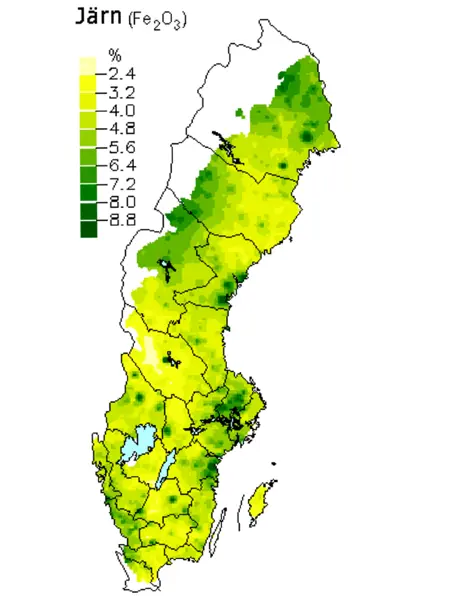
The map below shows the mean concentrations (in weight %) of iron oxide (Fe₂O₃) in forest land mineral soil at a depth of 50 cm.
Iron is the fourth most abundant chemical element in the Earth’s crust. Pure iron is soft, silvery white, and malleable. Iron has been known for approximately 6,000–7,000 years. The average iron content by weight in the accessible part of the Earth’s crust is estimated at 4.0–5.0%.
In Swedish bedrock and soil types, iron occurs mainly in dark rock-forming minerals (ferromagnesian or mafic minerals) as well as in greenstones as silicates. Examples of silicate minerals in which iron occurs to a limited extent include dark pyroxenes and amphiboles (e.g. hornblende), iron-rich olivine (fayalite), iron-bearing epidote (allanite), cordierite, garnet (almandine), chlorite, and biotite.
The economically important iron minerals, however, consist of various types of ore minerals. Examples in which iron is bound to oxygen include magnetite (72% Fe), hematite (70% Fe), goethite (63% Fe), and limonite (up to 62% Fe). Siderite is a carbonate compound containing 48.2% Fe. In the Bs horizon of podzol profiles, iron occurs as various forms of hydrated oxides that are more or less crystalline.
The mean concentration of Fe₂O₃ in Swedish forest soils is close to 4.44% Fe₂O₃, and the iron most likely originates from mafic silicate minerals and accessory ore minerals in oxide form. Areas with concentrations exceeding 4.8% Fe₂O₃ are probably influenced by the presence of greenstones in the bedrock. Compared with the average content in bedrock, the Fe₂O₃ concentration of soil materials in the C horizon is somewhat underrepresented.
Read more about the chemical element iron on Wikipedia.
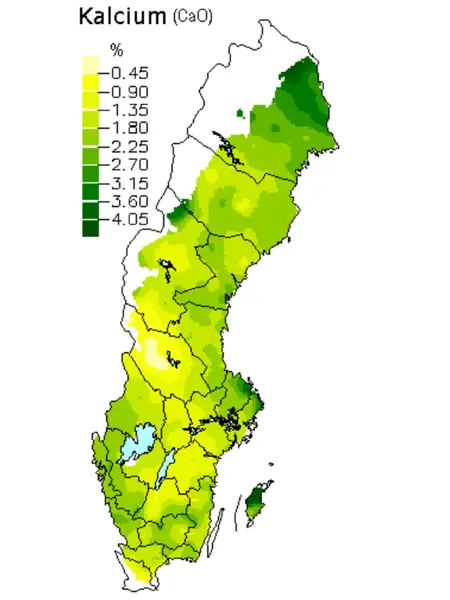
The map below shows the mean concentrations (in weight %) of calcium oxide (CaO) in forest land mineral soil at a depth of 50 cm.
Calcium (Ca) is the fifth most abundant chemical element in the Earth’s crust and occurs in nature mainly as silicates, carbonates, and phosphates. Limestone (CaCO₃) and lime have been known since antiquity. In Swedish bedrock and soil types, calcium occurs primarily in compounds with silicon (silicates). Exceptions to this occur in areas where limestone or other carbonate rocks are present in the bedrock and soils. Limestones (composed of the mineral calcite) occur mainly in close association with areas where Cambro‑Silurian sedimentary bedrock has been preserved. Such areas are found in the southwestern part of Skåne, on Öland and Gotland, on the Östergötland plain north of a line from Linköping via Mjölby to Omberg, the plateau mountains of the Västergötland plain, the Närke plain south of Örebro, the seabed of the Gulf of Gävle, the area around Lake Siljan in Dalarna, and west of the Östersund area in Jämtland. In addition, scattered occurrences are found along the Scandinavian mountain chain. Limestones of younger origin (from the Cretaceous period) occur in the Malmö, Kristianstad, and Båstad regions.
In the Precambrian bedrock, sporadically elevated calcium concentrations occur in crystalline limestones or dolomitic rocks (marble) in association with ore provinces.
The vast majority of calcium present in the Precambrian bedrock occurs as calcium silicates in rocks composed of minerals belonging to the pyroxene and amphibole groups, as well as in calcium‑rich varieties of feldspar (Ca‑plagioclase). Other minerals occurring as accessories include epidote and apatite. Colloquially, these minerals are often referred to as “basic minerals” or dark minerals, with a density exceeding 2.68 g/cm³. These minerals are characterised by varying proportions of magnesium and iron, but calcium is also associated with the formation environment of these basic minerals. In this context, it is iron that gives rise to the dark colour of the minerals. In general, basic rocks commonly referred to as greenstones tend to exhibit elevated calcium concentrations compared with common gneisses and granites. The most common examples of greenstones are gabbro, hyperite, diorite, diabase, basalt, and amphibolite (metabasite).
Calcium is an essential element for plants, animals, and humans. Calcium phosphate is a component of bones and teeth. The calcium ion is important for hormonal activities and is essential for cell division. In plants, the most important function of calcium is to stabilise cell membranes. Because calcium is a relatively common element in most soils, plants rarely suffer from calcium deficiency.
With regard to calcium in Swedish forest soils, it may be possible to distinguish two populations. One population, with an arithmetic mean close to 1.75% CaO, likely originates from soils dominated by gneiss and granite. Areas with concentrations exceeding 5% CaO are, however, presumed to be influenced by sedimentary limestones. In the latter case, soil processes may have contributed to the leaching of easily soluble calcite minerals from the uppermost soil horizons. The overall mean concentration of CaO in the 1,892 samples was 1.80%.
Read more about calcium on Wikipedia.
The map below shows the mean concentrations (in weight %) of potassium oxide (K₂O) in forest land mineral soil at a depth of 50 cm.
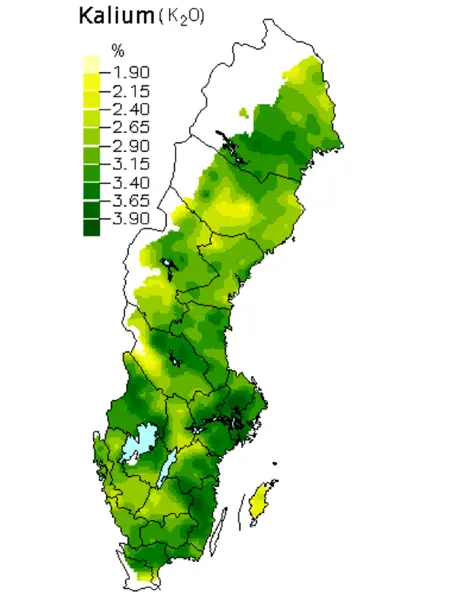
Potassium (K) is the seventh most abundant chemical element in the Earth’s crust. It occurs in the Earth’s crust mainly as silicates. During weathering of minerals, much less potassium than sodium is removed by water, because potassium ions are adsorbed and retained in the unconsolidated soil layers—particularly in clay minerals—much more strongly than sodium ions.
In Swedish bedrock and soil types, potassium occurs mainly in compounds with silicon (silicates). The dominant sources of potassium are feldspars such as microcline and orthoclase. In Sweden, potassium occurs almost exclusively in microcline and potassium-bearing micas (muscovite and biotite).
The mean concentration of K₂O in Swedish forest soils is close to 3.0 weight percent.
Potassium compounds have been known as constituents of terrestrial plants for centuries. By burning wood and leaching the ash with water, potash—potassium carbonate (K₂CO₃)—was obtained and used, among other things, in the manufacture of soap and glass.
The map below shows the mean concentrations (in weight %) of silicon dioxide (SiO₂) in forest land mineral soil at a depth of 50 cm.
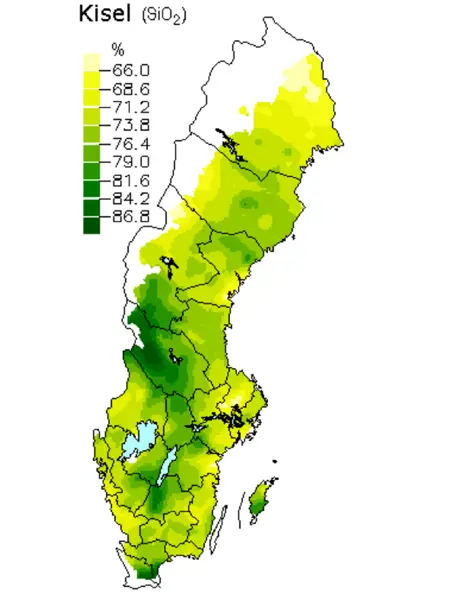
Silicon is the second most abundant chemical element in the accessible part of the Earth’s crust (with oxygen being the most abundant). The average silicon content of rocks in the Earth’s crust is 27.7%.
Silicon never occurs in a free state in nature and is almost exclusively bound to oxygen in silicon dioxide (SiO₂) and in various silicates. Silicon constitutes one of the principal components of most minerals. The common mineral quartz, for example, consists of pure silicon dioxide, SiO₂. A high silicon content in the parent material indicates a high proportion of minerals that are resistant to weathering.
In living organisms, silicon generally plays a minor role and is usually not regarded as a plant nutrient. However, many studies have shown that silicon uptake may have beneficial effects on plants, for example by providing protection against fungal diseases, increasing photosynthesis, reducing plant transpiration, and promoting the uptake of other elements.
In Swedish bedrock and soil types, silicon occurs mainly in two forms: as pure quartz minerals and as silicates containing various groupings of major elements. The most common groupings of rock-forming minerals include feldspars, amphiboles, pyroxenes, garnets, micas, and clay minerals.
The mean concentration of silicon dioxide in Swedish forest soils is close to 73.7 weight percent, indicating that the silicon content of the soil material considerably exceeds the average content of the bedrock, which is 67.5% SiO₂.
Read more about the chemical element silicon on Wikipedia.
The map below shows the mean concentrations (in weight %) of magnesium oxide (MgO) in forest land mineral soil at a depth of 50 cm.
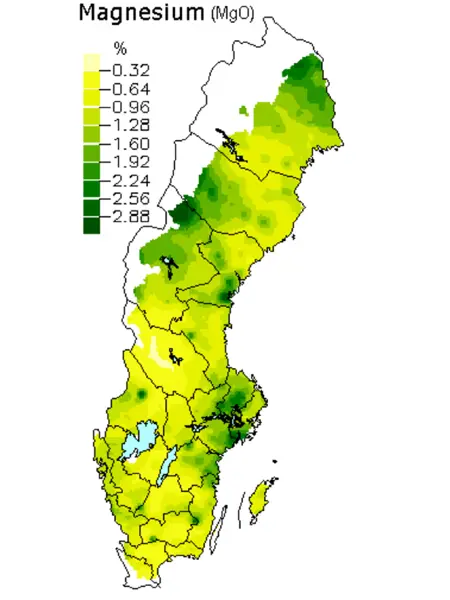
Magnesium is the eighth most abundant chemical element in the Earth’s crust and occurs in nature globally mainly as silicates, carbonates, as well as chlorides and sulphates. The average magnesium content of rocks in the Earth’s crust is 2.1–2.3%.
In Swedish bedrock and soil types, magnesium occurs almost exclusively in compounds with silicon (silicates). Exceptions to this occur in areas where magnesium-bearing carbonate rocks are present in the bedrock and soils. However, the magnesium content of sedimentary limestones is not particularly high.
In the Precambrian bedrock, sporadically elevated magnesium concentrations occur in crystalline carbonates (magnesite, very rare in Sweden) and dolomitic rocks (dolomitic marble) in association with ore provinces. In connection with certain types of ore formation, magnesium-rich solutions have affected the surrounding bedrock and contributed to mineral transformations, resulting in the formation of specific magnesium-bearing minerals. Such minerals are commonly referred to as skarn minerals.
The vast majority of magnesium present in the Precambrian bedrock occurs as magnesium silicates in rocks composed of minerals such as olivine, serpentine, enstatite, talc, asbestos, phlogopite, and biotite, among others. Many of these minerals belong to the pyroxene and amphibole groups. Colloquially, these minerals are often referred to as “basic minerals” or dark minerals, with a density exceeding 2.68 g/cm³. These minerals are characterised by varying proportions of magnesium and iron, but calcium is also associated with the formation environment of these basic minerals. In this context, it is iron that gives rise to the dark colour of the minerals. In general, basic rocks commonly referred to as greenstones tend to exhibit elevated magnesium concentrations compared with common gneisses and granites. The most common examples of greenstones are gabbro, hyperite, diorite, diabase, basalt, and amphibolite (metabasite).
The mean concentration of MgO in Swedish forest soils is close to 1.09% MgO and most likely originates from soils dominated by gneiss and granite. Areas with concentrations exceeding 1.7 weight % MgO are, however, presumed to be influenced by the presence of greenstones.
The element magnesium is a constituent of chlorophyll, the green pigment in plants, and is therefore essential for all green plants. Magnesium deficiency may occur on acidic soils where magnesium is outcompeted by aluminium. The maps show that there is considerable variation in the content of calcium and magnesium in the parent material. In particular, calcium- and magnesium-poor areas are found where nutrient-poor sandstone bedrock occurs, for example the Jotnian sandstone in north-western Dalarna.
The map below shows the mean concentrations (weight-%) of manganese oxide (MnO) in the mineral soil at a depth of 50 cm in forest land.
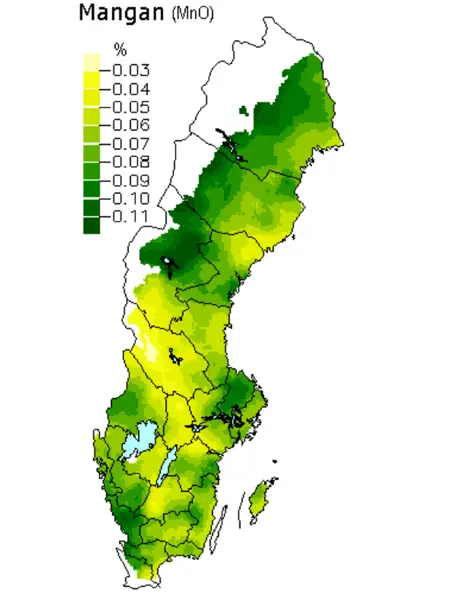
Manganese is the 12th most abundant element in the Earth’s crust. The average concentration of manganese in the accessible part of the Earth’s crust is 950–1000 ppm, i.e. 0.095–0.1%.
The mean value in Swedish forest soils is close to 0.07% MnO (700 ppm). Manganese most likely originates from mafic silicate minerals and accessory ore minerals in oxidized form.
Manganese functions as an essential trace element in living organisms. It is best known for its role in photosynthesis, where it is required for chlorophyll formation in green plants, although it is not a component of the chlorophyll molecule itself. The enzyme that converts water into oxygen contains a cluster of four manganese atoms, which utilize their ability to exist in different oxidation states and thereby bind varying amounts of oxygen.
Manganese is taken up by plants in the form Mn(II). This form oxidizes more readily as the environment becomes more alkaline. In alkaline soils, plants therefore show signs of manganese deficiency (often grey or pale spots on leaves) at much higher manganese concentrations than in more acidic soils.
The map below shows the mean concentrations (weight-%) of sodium oxide (Na₂O) in the mineral soil at a depth of 50 cm in forest land.
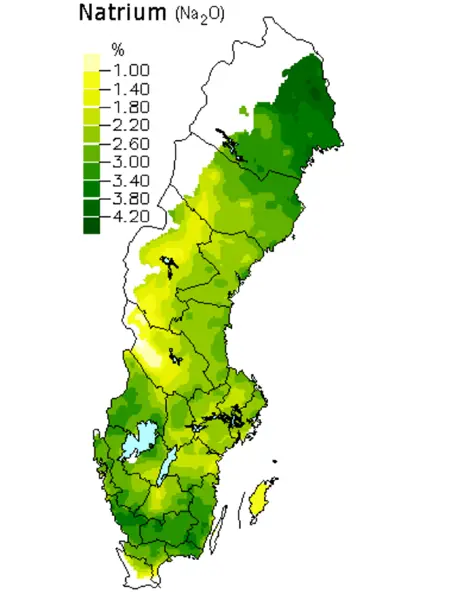
Sodium is the 6th most abundant element in the Earth’s crust. The average concentration of sodium in the accessible part of the Earth’s crust is 2.3–2.8%.
In Swedish bedrock and soil types, sodium occurs primarily as compounds with silicon (silicates). The dominant source of sodium is feldspars, such as the plagioclases. The largest proportions of sodium are found in albite and oligoclase. Sodium may occur at low concentrations or as a trace element in a large number of rock-forming minerals. This is because sodium can substitute for potassium in the crystal lattice. The Na₂O content in Swedish forest soils is on average close to 2.6 weight percent.
Read more about the element sodium on Wikipedia.
The map below shows the mean concentrations (weight-%) of titanium oxide (TiO₂) in the mineral soil at a depth of 50 cm in forest land.
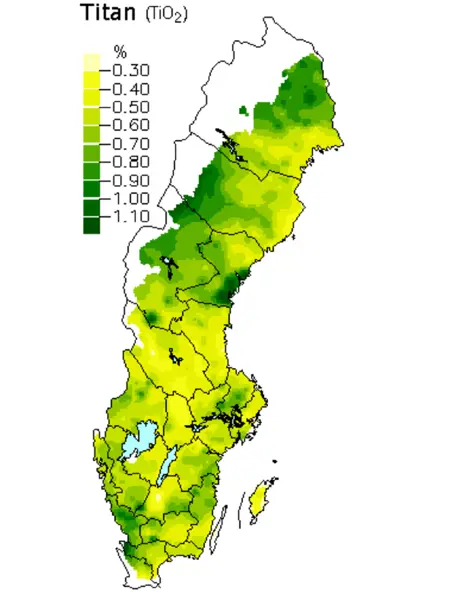
Titanium (Ti) is the 9th most abundant element in the Earth’s crust. It is widely distributed but occurs at relatively low concentrations. The average titanium content in rocks in the accessible part of the Earth’s crust is 0.44–0.60 weight percent Ti.
The element commonly occurs in minerals that are resistant to weathering. The most important mineral is ilmenite. Ilmenite also occurs as lamellae in magnetite (Fe₃O₄), forming titanomagnetite, and at sufficiently high concentrations, recovery of titanium may be economically viable after the magnetite has been removed by magnetic separation following crushing. Another important source of titanium is rutile, which is nearly pure TiO₂. A further titanium-bearing mineral is titanite (CaTiSiO₅). These minerals most commonly occur as accessory minerals in Swedish bedrock, for example in granites, syenites, carbonate rocks and magnetite deposits. In volcanic rocks, the titanium content is around 0.64% Ti.
In Sweden, only low-grade deposits occur (the largest quantity being titanomagnetite at Taberg in Småland; the highest titanium contents are found in ilmenite and titanomagnetite at Routevare, Kvikkjokk).
The mean titanium content in gneiss granites is around 0.31 weight percent, in fine-grained younger granites 0.17%, in coarse porphyritic Småland granites 0.66%, in red Växjö granite 0.49%, and in mafic rocks 0.61%.
The arithmetic mean concentration of TiO₂ in Swedish forest soils is close to 0.61 weight percent, which is higher than the global average for soils, estimated at 0.33%. Podzols and peat soils generally have lower concentrations according to Kabata-Pendias (2001).
Read more about the element titanium and its role in plant nutrition.
Contact
-
PersonJohan Stendahl, head of department and researcherBiogeochemistry of Forest Soils