Lateral Soil Water
The assessment of lateral soil water is conducted to gain an understanding of how long during the growing season trees can utilize moving groundwater. Tree growth is enhanced when there is access to lateral soil water.
About Lateral Soil Water
The classification of lateral soil water is mainly based on topography. On crests and far up on slopes, lateral soil water is absent, whereas at the foot of long slopes, it is present during most of the season.
However, management practices and interventions that effectively divert water that would otherwise reach the assessed area must also be taken into account. Examples of such interventions include ditches adjacent to forest roads or major public roads.
The water that flows at various depths and irregularly down a slope contains dissolved plant nutrients that benefit the vegetation further down the slope. Lateral soil water can also improve the oxygen supply within the root zone, which—particularly on moist land—results in significantly better production conditions than when the water is stagnant. Consequently, sites with laterally moving soil water often have high productive capacity.
The potential occurrence of laterally moving soil water is assessed based on data regarding the ground slope and the length of the slope above the center of the sample plot. When the assessment of lateral soil water was first introduced, four classes were used: Absent (saknas – SA), Seldom (sällan – SÄ), Present for shorter periods (kortare perioder – KO), and Present for longer periods (längre perioder – LÄ) (see figure below). Nowadays, classes SA and SÄ are typically combined into a single class: Absent (saknas – S).
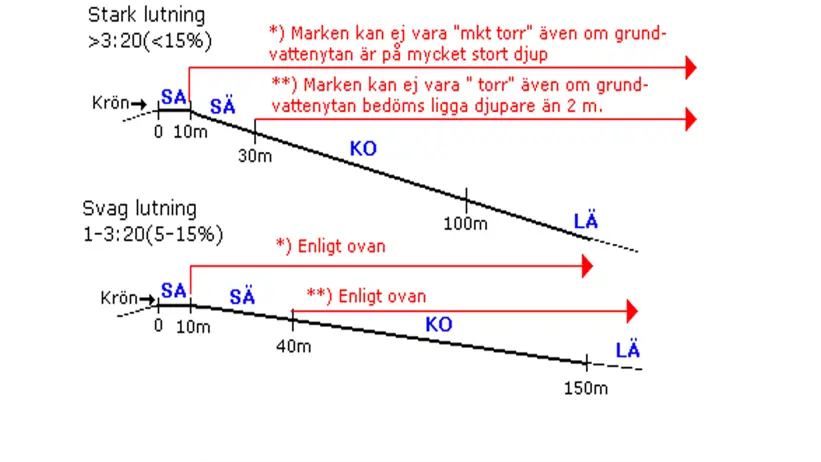
Schematic diagram in Swedish, showing how the classes for lateral soil water are assessed.
Contact
-
PersonJohan Stendahl, head of department and researcherBiogeochemistry of Forest Soils