The process behind a heritage interpretation plan for the world heritage site High Coast / Kvarken Archipelago
The world heritage site High Coast / Kvarken Archipelago decided to produce a heritage interpretation plan and the Swedish Centre for Nature Interpretation (SCNI) was hired to lead the process for that work.
From 2018 to 2020 several activities were held including an educational day, several workshops and try-outs of planned nature and activity trails, parallel with the writing process of the plan. A lot of local actors were involved in the process. This resulted in a better basis for future decisions about nature interpretation in the World Heritage site as well as development of methods for interpretive planning for us at SCNI. Here you can read about the working process.
Far from all world heritage sites have a plan for heritage or nature interpretation. According to UNESCO there are advantages with such plans in order to secure visitors' experiences of, understanding of and possibility to form relationship to the place and its values. Therefore UNESCO has decided that new candidates for World Heritage sites must present an heritage interpretation plan already in the application. The heritage interpretation plan that has been made for High Coast / Kvarken Archipelago is an example of a plan that has been made in an existing World Heritage site. The Swedish Centre for Nature Interpretation (SCNI) contributed with support throughout the whole process - here we tell you more about what happened in the process.
Background
The High Coast / Kvarken Archipelago is a world heritage site shared between Sweden and Finland. Here the land uplifting processes are in focus. The rising mountain tops of the High Coast with a view over the sea in the west and Kvarken Archipelago that mainly consists of moraine ridges in the east, have together been pointed out by UNESCO as the best area in the world for understanding land uplifting and how the latest inland ice sheet affected the landscape. The County Administrative Board in Västernorrland and the Finnish state-owned company Metsähallitus gave in 2018 SCNI the assignment to facilitate the process in wich the two World Heritage administrations were to produce a heritage interpretation plan for the area. This process was done within the framework of the large EU project Lystra.
The goal with the project was to welcome more visitors to the World Heritage site without jeopardizing a sustainable development, to increase the understanding of the values of the World Heritage site and to create a high class knowledge base in order to meet the needs of both nature tourism and of land use planning. With the help of the heritage interpretation plan they wanted to highlight the unique values of the world heritage site and to find a common story of the whole World Heritage site. The plan would describe how the World Heritage site should be presented on both physical and digital visitation sites. The purpose was that the visitors would get a better experience and understanding of the World Heritage site and its values.
SCNI has since 2014 participated in and/or supported several planning processes within heritage interpretation:
- the preparatory work for the establishment of Åsnen National Park 2014 as an assignment of the Swedish EPA.
- interpretive planning in the World Heritage site Birka and Hovgården in 2015 and in the area called Bergslagen 2016-2017 as an assignment of the Swedish National Heritage Board.
In the project in Bergslagen it was included to produce the method tutorial Platsens berättelser (in English The stories of the Place), which is published at the Swedish National Heritage Board. 2018 the Swedish EPA published the handbook Naturvägledning i natur- och kulturområden (in English Nature Interpretation in Natural and Cultural Heritage Areas), produced by SCNI as an assignment from and in cooperation with the Swedish EPA. The handbook is supposed to function as a support for mainly the Regional Administrative Boards in their planning of heritage interpretation. 2014-2017 SCNI participated in the research project Planning of heritage interpretation, meaning and systems thinking, that was funded by the Swedish National Heritage Board and under the direction of the Division of Environmental Communication at SLU.
SCNI's ambition in participating in the work with the heritage interpretation plan for the World Heritage site High Coast / Kvarken Archipelago, except to contribute to the direct project goals, was to continue to develop knowledge about planning of heritage interpretation. This time in a World Heritage area with relatively complex phenomena where there already was a lot of information for the visitors. An area shared by two countries, national administrations and language areas, and in a cooperation process with a great amount of local administrations and actors that are involved in communication with visitors.
This is how it went
SCNI visited the World Heritage site
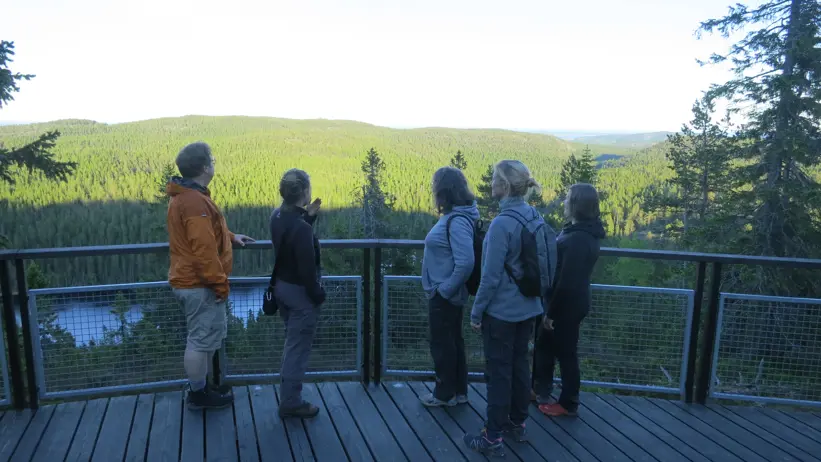
In May and July 2018 CNV visited both High Coast and Kvarken Archipelago in order to get our own perception of the World Heritage site, its values and to be able to take part of already existing heritage interpretation and the different adminstrations' current planning. The visits contributed to valuable knowledge for the continued work with the heritage interpretation plan.
Educational day and workshops
As part of the process to create an interpretation plan is to include all relevant actors active within the heritage site. This was done by an educational day and two workshops.
The educational day was held in Vasa in Finland in September 2018. The focus was on heritage interpretation and on the methodolgy specifically around thematic interpretation. The goal was to create a platform for and deaper understanding of how thematic heritage interpretation could benefit the communication efforts around the World Heritage site. During the day the participants also started working on producing a theme for the heritage site. The participants came from the organizations working with the Lystra project and from the financing organizations.
Two workshops were held with local actors. Everybody involved in communication and pedagogics within the World Heritage site was invited: enterprises, associations, schools, municipalities and other organizations. In October 2018 one workshop was held in Vasa in Finland. The second one was held in January 2019 at High Coast in Sweden.
The participants worked together to create a common theme for the whole World Heritage site. The theme constitutes the core message or read thread in all the actors' communication with the visitors. Among other things this was discussed:
- how should the theme be formulated so that it is easy to use
- how could the theme be communicated in the best way
- how could the actors in their enterprises benefit from using the common theme of the World Heritage.
During the workshops the participants also identified the most important places in the heritage site and discussed how these places could be promoted for different visitors with different aims with their visit. These following questions were discussed:
- How should the World Heritage be presented in different sites so that the common theme is understood by all the different visitor groups?
- Which sites are most important to make accessible?
- How do we reach the families? The adventurous? The ones interested in culture?
- Which are the most important places to visit in the World Heritage?
- Do the different sites give a good representation of the World Heritage, that is, do the sites represent all different traces from the ice age, the land uplift and the sea?
- Where is the idea behind the UNESCO World Heritage presented and how the High Coast - Kvarken world heritage is part of a family of over 1000 sites?
The collaborative process that is ongoing in both the educational day and the workshops between the participants is very important. It is important to meet the other actors that work in the World heritage with different things and have different background and together create a common understanding for heritage site and what to communicate.
The development of the heritage interpretation plan
Parallel with the workshops the writing process of the heritage interpretation plan was started. It resulted in this website High Coast Kvarken Archipelago - World Heritage and a nature interpretation plan for the world heritage (pdf in Swedish).
Tests and evaluations
Two trials of heritage interpretation were made on site in the World Heritage with the heritage interpretation plan as a support. The trials were performed at Hornöberget on the High Coast during summer 2019 and at Svedjehamn in Kvarken Archipelago during summer 2020.
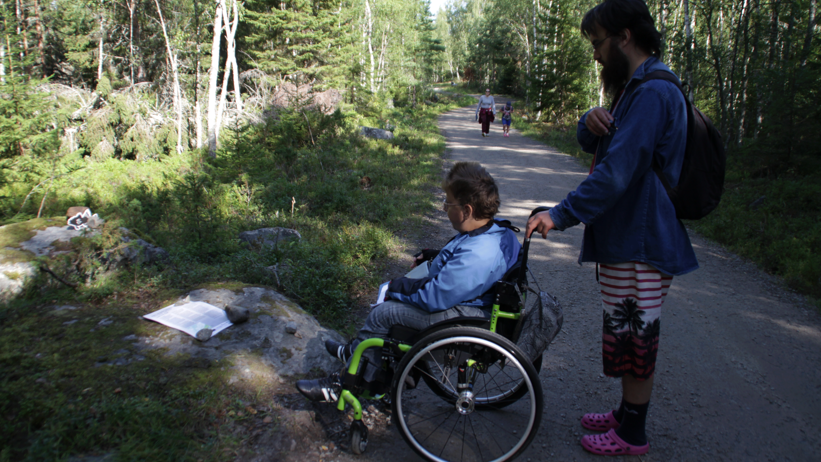
Experience/nature paths of different characteristics were planned for both these sites. Before the trials, temporary versions (prototypes) of, for example, direction markings, signs, models, u-turns (self powered wind up audio players), treasure chests were made. This made it possible to test the planned heritage interpretation before it was in place. People that represented the different intended target groups were invited to test, reflect over and assess the heritage interpretation. The trials were performed by the Regional Administrative Board of Västernorrland and Metsähallitus in cooperation with SCNI.
Conclusions and what to think about for similar projects
Anna Carlemalm from the Regional Administrative Board of Västernorrland and Malin Henriksson from Metsähallitus think that it has been good to have external experts that guided them through the process, especially in the beginning. They feel that they themselves now have become experts and developed a deeper knowledge about heritage interpretation in the World Heritage site, and that they because of this more freely can elborate and adjust it to their needs etc.
They also think that it has been good that the process was allowed the time it took, from collecting background facts about places and visitors, via workshops to an ongoing process of writing and comments on that. It has contributed to a good end result.
For SCNI the initial educational day for the people involved in the project was valuable as a basis. It contributed to a mutual level of knowledge about heritage interpretation in the continued work.
Anna and Malin think that the workshops with the local actors were important. That way the public got involved in a good way. They also think that it was good that the workshops were held in both countries and that several people from the administrations were able to participate and to contribute to their content. This contributed to that the the working group became more close knit. Also SCNI thinks that the workshops resulted in sought after input about involvement, suggestions on visiting sites and development ideas as well as to valuable anchoring with and contact channels to the local actors.
It is significant to get a good idea of who the visitors to the World Heritage site will be. That knowledge steers decisions for which groups the heritage interpretation should be aimed. These decisions were made easier because of recent visitor surveys.
It can be a challenge to formulate and create a main theme (with the method thematic interpretation) that is interesting and relevant enough for visitors. Because of this, SCNI emphazise that it is important to, during the whole process of producing an interpretation plan, continously working on its preliminary main theme. This will provide good support in the process.
In order to make the heritage interpretation plan user friendly, it should be clarified in the document how it is meant to be used, who it is meant for and how to follow up set goals for continuous development.
It has worked well with frequent video meetings for the working group. A lesson made is to make sure that meetings are regularly booked when everybody in the working group can discuss the process and update what needs to be done.
For SCNI's overall work with method development of nature interpretation, it has been very valuable to follow the work during the whole process, parallel with the implementation of the concrete process facilitation assignment. How the formulation of themes took place in collaboration between many actors, how the project organization used the emerging plan in its pilot trials, how visitors at the pilot trials reflected on their experiences and finally how the administrations in their turn received and used that knowledge in further planning.
The focus on cooperation with local actors in the discussion about communication and themes has, as far as SCNI can assess, been valuable for the process. That in combination with the implementation of the pilot trials where the heritage interpretation is being tested in practice, results in that the whole process allows for different perspectives as well as room to respond to visitors' interests and reflections.
Other results from the work with the heritage interpretation plan
Inspired by the development of the heritage interpretation plan, two initiatives have been made in Finland:
- The Association of World Heritage Sites in Finland has a common project about interpretation in the Finnish World Heritage sites. In the project a common theme will be developed for the seven World Heritage sites, as well as an individual theme for each World Heritage site.
- The project of Kvarken Archipelago called Man and land uplift (Människan och landhöjningen) is based on the cultural-historical subtheme of the heritage interpretation plan. The focus in the project is on the connection between humans and the by land uplift changing landscape in the Kvarken Archipelago.
Both projects were mainly financed by the Finnish Ministry of Education and Culture through project funds for development of cultural tourism in World Heritages sites.
Links
The heritage interpretation plan for the World Heritage High Coast / Kvarken Archipelago.
Contact
-
SLU Swedish Centre for Nature Interpretation (SCNI)