Dokumentation Nature Interpretation webinar no.3
Holding Fire: Conversations of reparation, relation, and transformation. Friction fire, tea ceremony and transformative conversations. Mingle through a Fire-making workshop with Nature Interpretation Lab Workshop, with Society for Transformative Conversation
The mingle was held on March 18th 2025
Fifteen of us gathered on this spring day, not simply to witness fire being made, but to kindle something deeper—dialogue that felt elemental, embodied, and ancient. This workshop, organized by the Nature Interpretation Lab and the Society for Transformative Conversation, and held by researcher-practitioner Maxim Vlasov, invited us into a shared space of inquiry, practice, and presence. Set in a forest clearing behind Kunskapparken, the fire-making workshop was more than an event; it was an offering—a circle where conversation could take root.
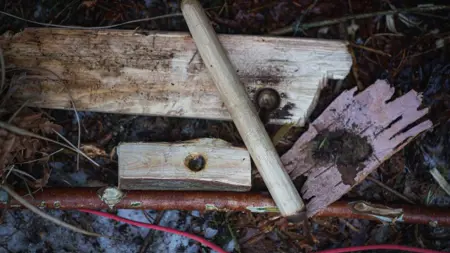
A group of participants walked in silence, contemplating their relationship with fire. They were greeted by the organizer and received a bark – as ticket to the space. Sitting in a circle, we could hear black birds and woodpeckers also joining the meeting although perhaps observing in a distance. After a short introduction to the workshop, the bow drill fire making technique demonstration by Maxim Vlasov unfolded with quiet intention. The friction, the smoke, the rhythmic effort—these ancient gestures felt both foreign and deeply familiar. As sparks emerged from the spindle, and fire kindled the “tinder nest”, we shared the fire with our ‘bark tickets’ and together made the fire in the center, already prepared to be lightened. A kettle of water gets heated up. As doing so, we began to settle into the elemental rhythm. The fire-making became a metaphor for the conversations that followed: effortful, slow, and generative.
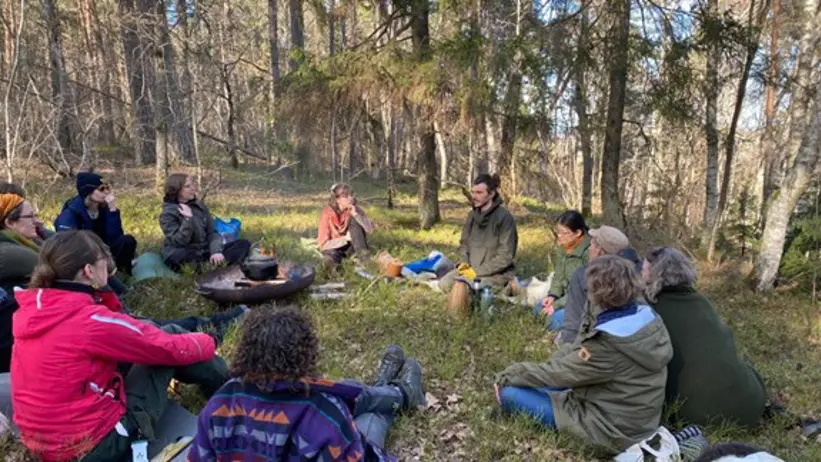
Maxim then told a story of fire making, weaving together all materials required for carrying out this technique, how they used to live side by side humans in their natural habitats, how slowly we lost our memories of these ancient knowledge, and how we could repair our relations with these non-human species through learning to be humble again: humans have always been together with nature and taken assistance from others in nature, and with respect and permission, we may remember how it feels again. Everyone was invited to share their stories with fire-making, it became immediately apparent that not so long ago fire has been more visible in our daily life.
With the fire lit, fireweed tea was prepared and we learned about this magnificent plant. Fireweed, with its magenta plumes rising from disturbed ground, is nature’s quiet healer—a first responder in the wake of wildfire, landslide, or human neglect. It does not retreat from ruin but weaves its roots into the wounded soil, calling back the bees, feeding deer, and cradling light with each slender stalk. Once gathered for tea and medicine, used for making rope and clothes, fireweed’s gifts were known to those who walked slowly and listened. As we sipped the sweet scented tea, we also shared rich knowledge and memory of fireweed, its different names in different parts of the world, how we learned about it, and what it could mean for society today. The tea ceremony invited us to breathe slower, speak softer, and listen more deeply.
As conversation opened, we explored friction and relation—both between people and between human and more-than-human kin. We considered how ancestral skills might repair frayed ecological relationships. Themes surfaced around ritual, vulnerability, resilience, and reverence. The forest offered its own silences between our words. One participant noted how the space felt 'intimately expansive,' a paradox that held true throughout. Another participant pointed out that the place is a co-facilitator. It wasn’t only the program that held us—it was the atmosphere itself. The gathering felt safe not because difficult things were avoided, but because we moved and conversed together with care. People paused before responding. Stories were shared without urgency. The mood was intimate, inspired, and quietly transformative.
This workshop reminded us that nature interpretation can be an invitation to slowness, embodiment, and co-presence. Future gatherings might take inspiration from this blend of ritual and spontaneity, intimacy and inquiry. Participants were invited to try out the technique and with hand-on practices the senses entered another dimension. We left with the faint smell of smoke in our scarves, and something else—an ember of possibility.
Maxim Vlasov is a researcher-practitioner from Umeå with interest in ancestral skills and cultural rewilding, including applications of these ideas in the contemporary outdoor education and recreation. Alongside his academic work, he runs his own practice as wilderness skills instructor and currently teaches at the year-long course Naturliv at Munka Folkhögskola. At this workshop, he demonstrated the ancient technique of bow drill (friktionseld med bågdrill) and shared fireweed tea. We gathered around the fire, listened to stories and tasted the fireweed tea.
We talked about our thoughts on friction and relations: how can ancestral life skills help us repair the broken relationship with more-than-human kin? We will also reflected together on this type of nature interpretation – what types of conversations are enabled in these situations, what is opened up and what is closed?
Contact
-
SLU Swedish Centre for Nature Interpretation (SCNI)