
When farmer well-being meets animal welfare
Improving calf welfare is not only about management and housing practices (e.g. feeding) – it is also about the people behind them. This interdisciplinary project explores how technology, working conditions and social sustainability are interconnected within a One Health perspective.
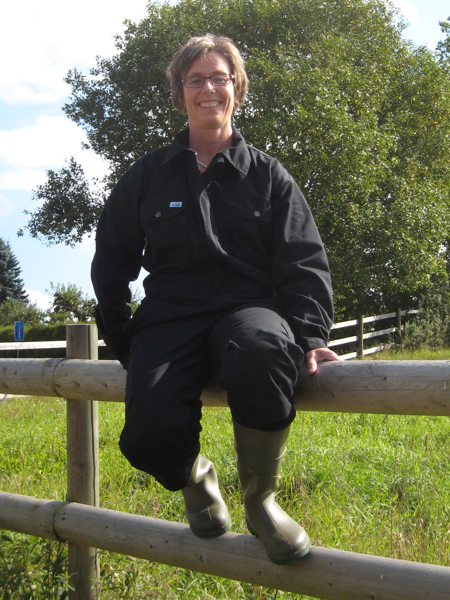
Meet Catarina Svensson, Professor at the Department of Clinical Sciences at SLU. Here, she shares insights from one of her research projects: Socially sustainable calf management for better animal welfare – how can technology contribute?
Hi Catarina,
Could you briefly describe your project – its main objectives and what you hope to achieve?
This is an applied, interdisciplinary research project at SLU, conducted in collaboration with Uppsala University and the advisory organisation Växa Sverige. The project explores how automated milk feeders (AMF) influence calf welfare, as well as the working conditions and everyday lives of dairy farmers and farm staff.
A central aim is to understand both the challenges and opportunities of using this technology – for animals and for people. In particular, we examine how AMF can support recommended feeding practices for calves, while also improving working conditions and enabling a more sustainable work–life balance for farmers.
The project builds on previous research showing that social sustainability in calf management is a key barrier to providing adequate milk allowances. We therefore investigate whether automation can contribute to improved animal welfare by reducing workload and supporting more flexible work practices.
Our interdisciplinary team combines expertise in veterinary medicine, animal welfare, cognitive science and human–technology interaction. Using qualitative social science methods – such as in-depth interviews and focus groups – we explore farmers’ and farm workers’ experiences in practice. In a second phase, we work together with farms in a co-creation process to develop knowledge on what constitutes meaningful and effective use of this technology.
How does your research relate to the One Health concept?
High workload and mental health challenges among farmers are increasingly recognised as a sustainability issue in modern dairy production. At the same time, animal welfare depends strongly on the conditions under which people work.
This project explores the interconnections between human well-being and animal health and welfare – for example, how reduced workload and improved work engagement can support better calf care and welfare, which in turn may further enhance farmer well-being.
In this way, the project reflects the core of the One Welfare perspective, where human, animal and system-level factors are closely interconnected. It is also closely aligned with the One Health framework, highlighting the mutual benefits of improving both human and animal conditions.
What are the main challenges in this field – and where do you see the biggest opportunities?
One key challenge is that qualitative social science methods are still not widely used in veterinary research. As a result, there is sometimes limited understanding of these approaches in the peer-review process, which can make publishing such research more difficult.
Another challenge is the relatively small number of social scientists working within veterinary science. This makes it harder to build stable interdisciplinary teams and develop a shared language and understanding across disciplines over time.
At the same time, the opportunities are significant. Integrating social science perspectives into veterinary research helps us better understand how change happens in practice – or why it does not. This is essential for developing recommendations that are not only scientifically sound, but also feasible and more likely to be implemented.
Working across disciplines is therefore both intellectually enriching and crucial for addressing complex challenges within One Health.
More about the project:
Collaborator: Anna-Lena Hegrestad from Växa Sverige and Jessica Lindblom from Uppsala Universitet.

Contact
-
PersonCatarina Svensson, Professor