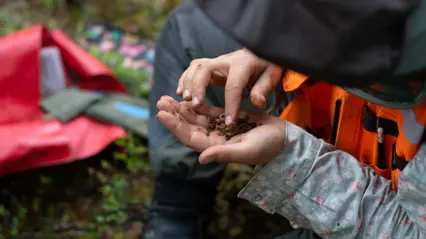
About the inventory
Here you can read about how our field inventory is carried out, which tasks are included, and what happens to the data we collect.
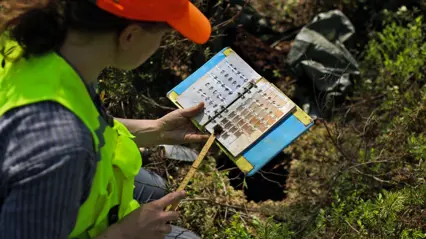
Data
Would you like to know more about our collected data and our database MiBas?
Markinfo
Results from the Soil Inventory are published in, among other places, the information system MarkInfo. The information is in Swedish,

Svampar i Sverige
Here you can view the results of the DNA samples collected by the Soil Inventory.
The greenhouse gas inventory
Read more about the greenhouse gas inventory and reporting to the UN and the EU.
Brief overview of the Soil Inventory
The Soil Inventory is part of the Swedish Environmental Protection Agency’s national environmental monitoring program. The inventory began in 1983 in collaboration with the Swedish National Forest Inventory and has since monitored the environmental status of Sweden’s forest soils and other natural lands. Each year, inventory and sampling are conducted at about 2,000 permanent sample plots. The samples are used for analyzing the soil’s chemical properties and determining the fungal community composition using DNA methods. The inventory produces data used in Sweden’s climate reporting to the UN and the EU, in national environmental goal follow-ups, in research, and as information for the public.
The inventory is conducted by the Department of Soil and Environment at SLU and falls under the Forest Program within SLU’s ongoing environmental analysis.
News
-
Spruce volume increases across Sweden – despite shrinking areas suited under future climate
Climate projections indicate that large parts of southern Sweden may become unsuitable for spruce by the end of this century. But the current management trends are moving in the opposite direction: spruce volume is increasing. -
Archived tree cores reveal why boreal forests are getting starved for nitrogen
Despite decades of industrial deposition, nitrogen availability in the boreal forest is steadily declining. In a new study published in Nature, researchers from the Swedish University of Agricultural Sciences have found that atmospheric CO₂ is the main driver - using decades of unique, stored data. -
Strong sunlight limits plant diversity and biomass in grasslands
The sun is the basis for photosynthesis, but not all plants thrive in strong sunlight. Strong sunlight even constrains plant diversity and plant biomass in the world's grasslands, a new study shows. Temperature, precipitation, and atmospheric nitrogen deposition have less impact on plant diversity. -
Digital innovation hub boosts forest sector in northern Sweden
How can SLU’s goldmine of forest data be put to the best possible use? Through Digital Impact North, a collaborative network for digital innovation, powerful tools have ended up in the right hands at more than 100 public and private actors in northern Sweden – leading to award-winning products. -
Tracking climate shocks to build future resilience
What can past climate extremes teach us about resilience? Researchers at SLU’s Interdisciplinary Academy (IDA) are studying long-term data on climate, farming, soils, and society to uncover patterns that could help us adapt to future challenges.