
Functional forest landscapes for pollinating insects
Project overview
Participants
More related research
Short summary
Pollinating insects are essential for biodiversity, functioning forest ecosystems and important ecosystem services. This PhD project investigates how forest structure, microclimate and the availability of flowering plants influence pollinating insects in forest landscapes.
Globally, pollinating insects are declining at a rapid pace, with climate- and land use change being considered the main drivers. During the last century, Swedish forests have experienced substantial structural changes due to a shift and modernisation in forest management practices, resulting in a homogenisation of the forest landscape and causing threats to many forest living species.
Frest structural complexity, microclimatic conditions and flower availability all play crucial roles for forest pollinating insects. However, the extent to which these variables impact pollinators in our Scandinavian forests remains unclear.
The overarching aim of this PhD project is to disentangle the relative importance of forest structural complexity, microclimate and flower availability for forest pollinating insects. To expand our knowledge in this area, we are working on the following projects:
1. Pollinator diversity and community composition in relation to forest structural complexity, flower abundance and microclimate
The forest microclimatic conditions set the abiotic boundaries that limit which pollinating insects can exist in a forest. The structural complexity of a forest determines the nesting resources available, while the flower abundance determines the amount of feeding resources available. Better understanding of these drives is crucial for the long-term preservation of pollinators, as well as for ensuring future pollinating services within these ecosystems. We are considering including wild bees, butterflies, hoverflies and moths in this project.
2. Bumblebee nest site selection, performance and reproduction in relation to forest structural complexity, flower abundance and microclimate
The objective of this project is to explore how forest structural complexity, flower abundance, and microclimatic conditions impact bumblebee nest site selection and colony performance, while also identifying the importance of each variable in relation to these processes.
3. Pollination of forest keystone plant species in relation to forest structural complexity, microclimate and pollinator community composition
The ground vegetation of Scandinavian boreal and hemiboreal forests is typically covered by dwarf-shrubs such as bilberry and cowberry, which rely heavily on pollinating insects for their berry production. The aim of this project is to understand how forest structural complexity, microclimate and pollinator community composition affect the pollination of the most common dwarf-shrubs of Scandinavian forests.
Study design
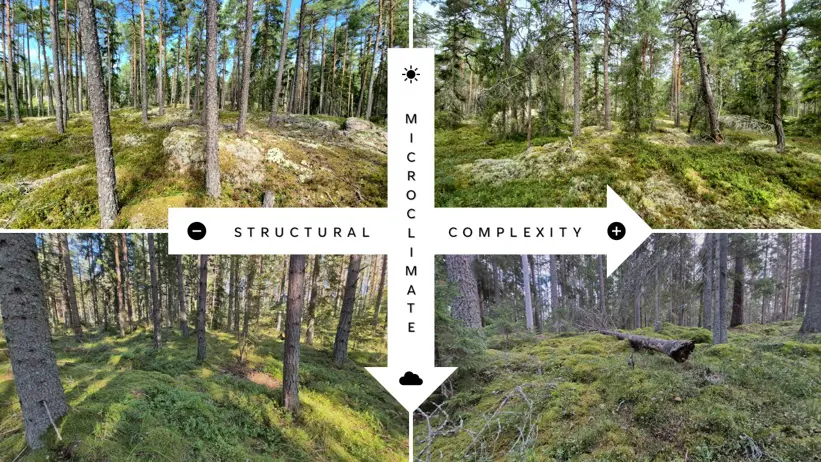
To study these topics, we have set up a study system with a total of 60 forest stands located in Uppland, Sweden. The forest stands vary across two gradients: structural complexity and microclimatic conditions, see illustration below.
The project offers opportunities for student thesis projects and internships.
The study system enables investigations of a wide range of ecological questions related to forest structure, microclimate and different organism groups.
Research Team
PhD student: Isac Carlsson, Department of Ecology, SLU
Main supervisor: Erik Öckinger, Department of Ecology, SLU
Assistant supervisors:
Joachim Strengbom, Department of Ecology, SLU
Per-Ola Hedwall, Southern Swedish Forest Research Centre, SLU
Maj Rundlöf, Department of Biology, Lund University
Project period: May 2025 – May 2029
This project is part of WIFORCE – the Wallenberg Initiative in Forest Research, funded by the Knut and Alice Wallenberg Foundation.