GS-VMAS PhD Courses
Here you find information about all our upcoming PhD courses
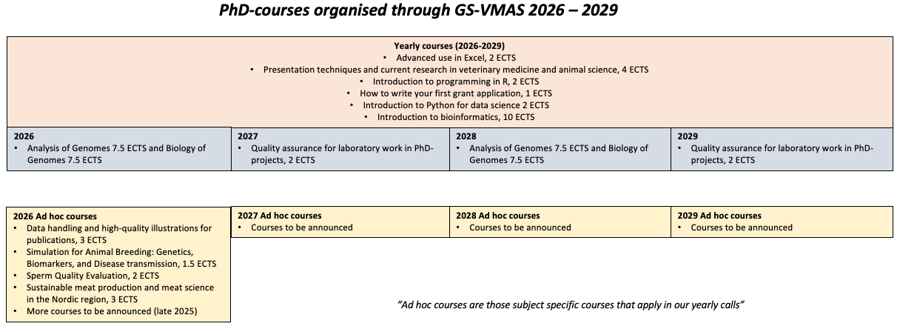
Recurring PhD courses 2026 - 2029
During 2026 - 2029 we will have a number of PhD courses that will be run on a regular basis (yearly and every second year) (to download). However, in addition to these we will also arrange a number of additional subject specific courses ("ad hoc") every year. Further information about all planned PhD courses can be found under "Upcoming PhD courses".
Upcoming PhD courses
Course code: PVG0044
Credits: 4
Course dates: Join continuously
The course has a dual format. One part is to actively participate in two workshops (4 hours per workshop) dealing with both oral and poster presentation techniques and the practical construction of a poster. Another part is to actively participate in >20 seminars given in the course seminar series. The seminar series will have weekly seminars during the spring and autumn semesters.
Course syllabus
Course code: P000186
Credits: 1.5 hp
Course dates: 2026-08-31 - 2027-06-20 (approx. 8 seminars in total (4 per semester); each seminar will be 2 hours (1 hour presentation and 1 hour discussion)): Planned seminar dates for the autumn semester are 18 Sep, 16 Oct, 17 Nov. A fourth date will be announced later as well as the 2027 sprin dates.
Vector- and reservoir-borne infectious diseases pose increasing challenges to animal and human health in a changing world. Climate change, land-use alterations, and globalisation are reshaping the distribution of vectors, wildlife reservoirs, and pathogens, creating new risks and research questions.
This course provides an in-depth exploration of vector- and reservoir-borne diseases from the perspectives of infection biology, ecology, and One Health. Through a series of thematic seminars led by international experts and researchers from SLU, participants will examine the interactions between pathogens, hosts, and vectors or reservoirs. Topics include tick-borne, mosquito-borne, midge-borne, rodent-borne, bat-borne, and avian-borne infections, with case studies such as Crimean-Congo haemorrhagic fever integrating pathogen biology, vector ecology, and environmental and climate-related aspects.
Each seminar is followed by a course-related activity for registered PhD students, providing opportunities for critical reflection, interdisciplinary dialogue, and connection to participants’ own research projects.
Note: If you are having trouble accessing the registration page, please try clearing the cookies associated with personalkurser.slu.se in your web browser and then reload the page.
If you are still unable to register for a course, please email the information listed below to gs-vmas@slu.se, and we will process your registration manually.
- First name
- Last name
- Personal identity number ("personnummer" or date of birth if you dont have a Swedish personnummer)
- Job title (e.g. PhD student, resident, researcher)
- Affiliation
Course code: P000172
Credits: 1.5
Course dates: 21 Sept - 2 Oct 2026 (21–25 September: Hybrid teaching with lectures and exercises on campus and via Zoom. 1–2 October: Oral presentation of your own project on Zoom)
This PhD level course provides an in-depth exploration of simulation methods applied to key areas of animal science, animal breeding and genetics. Students will learn how to simulate and analyse different types of data, ranging from production and performance traits to molecular and epidemiological data, within animal populations. The course integrates core statistical frameworks — including linear models for both univariate and longitudinal observations — with advanced simulations of breeding programmes in species such as cattle, pigs, broilers and fish.
The course also considers the simulation of complex data structures, such as biomarkers and RNA-Seq datasets, and addresses the challenges of molecular phenotyping and multi-level data integration. The final module explores behavioural and epidemiological modelling, including the use of social network data and stochastic transmission models to simulate disease dynamics and interactions between individuals.
Throughout the course, students will engage with realistic scenarios and datasets, gaining hands-on experience of contemporary tools and approaches currently used and demanded in animal breeding research and industry
Note: If you are having trouble accessing the registration page, please try clearing the cookies associated with personalkurser.slu.se in your web browser and then reload the page.
If you are still unable to register for a course, please email the information listed below to gs-vmas@slu.se, and we will process your registration manually.
- First name
- Last name
- Personal identity number ("personnummer" or date of birth if you dont have a Swedish personnummer)
- Job title (e.g. PhD student, resident, researcher)
- Affiliation
Course code: PVG0042
Credits: 3
Course dates: 21 - 23 September and 6 - 7 October 2026
The course will consist of a series of lectures, exercises and journal discussions. Two key issues related to questionnaire design and management as well as methods for evaluating and dealing with missing data. Multiple imputation to handle missing observations will be tackled.
After attending this course you will be able to:
- describe the principles of questionnaire design
- explain the psychology of respondent communication
- construct questionnaire studies and manage incoming data with high internal and external validity
- explain how missing observations arise in questionnaire studies and their impact on validity
- use multiple imputation methods to handle missing observations
Note:If you are having trouble accessing the registration page, please try clearing the cookies associated with personalkurser.slu.se in your web browser and then reload the page.
If you are still unable to register for a course, please email the information listed below to gs-vmas@slu.se, and we will process your registration manually.
- First name
- Last name
- Personal identity number ("personnummer" or date of birth if you dont have a Swedish personnummer)
- Job title (e.g. PhD student, resident, researcher)
- Affiliation
Course code: PVS0151
Credits: 2
Course dates: 12 – 16 October 2026
The course covers the following fields: the concept of sperm quality, what it is and why it is needed in different situations; how it is evaluated from basic field laboratory to advanced research setting; how it is used for different species; pitfalls in sperm quality evaluation; how it can be improved in the future. There will be a series of tutor-led lectures, workshops and practical sessions.
Note: If you are having trouble accessing the registration page, please try clearing the cookies associated with personalkurser.slu.se in your web browser and then reload the page.
If you are still unable to register for a course, please email the information listed below to gs-vmas@slu.se, and we will process your registration manually.
- First name
- Last name
- Personal identity number ("personnummer" or date of birth if you dont have a Swedish personnummer)
- Job title (e.g. PhD student, resident, researcher)
- Affiliation
Course code: PVS0141
Credits: 10
Course dates: 2 Nov 2026 - 17 Jan 2027
The course aims to give the student a solid foundation in the basic methods of bioinformatics. It will cover the theories, algorithms and practical applications of computer-based methods for analysis of DNA sequences and protein structures. The topics to be covered include: - biological databases - homology analysis - sequence analysis (with emphasis on the package EMBOSS and UGENE) - statistics and R introduction - web-based tools for analysis - the Unix operating system - phylogeny - comparative genomics - functional genomics - Next Generation Sequencing (NGS).
Note: If you are having trouble accessing the registration page, please try clearing the cookies associated with personalkurser.slu.se in your web browser and then reload the page.
If you are still unable to register for a course, please email the information listed below to gs-vmas@slu.se, and we will process your registration manually.
- First name
- Last name
- Personal identity number ("personnummer" or date of birth if you dont have a Swedish personnummer)
- Job title (e.g. PhD student, resident, researcher)
- Affiliation
Course code: P000122
Credits: 3
Course dates: 14th Jan – 22nd June 2027 (Lectures and seminars are held once a week every two weeks)
The famous evolutionary biologist Theodore Dobzhansky stated “Nothing in biology make sense except in the light of evolution”. This is certainly true for physiology. In the discipline of comparative physiology we try to understand how animals work and why they work the way they do. The comparative approach, i.e. comparing how different animals solve physiological problems, give us information on how physiological mechanisms have evolved and made adaptation to widely different environments and life styles possible. This gives a deeper understanding of physiological mechanisms, knowledge needed for management of domesticated animals as well as for understanding of the effects of challenges induced by environmental contaminations, global warming etc.
In this course the main focus will be on vertebrates even though we will include examples from invertebrates when appropriate for the understanding of specific physiological mechanisms. The course will consist of several themes including: energy metabolism, biochemical adaptation, respiration, circulatory system, osmoregulation, nervous system and sensory physiology, movement, living in extreme environments (e.g. living without oxygen, low temperature, etc)
Note: If you are having trouble accessing the registration page, please try clearing the cookies associated with personalkurser.slu.se in your web browser and then reload the page.
If you are still unable to register for a course, please email the information listed below to gs-vmas@slu.se, and we will process your registration manually.
- First name
- Last name
- Personal identity number ("personnummer" or date of birth if you dont have a Swedish personnummer)
- Job title (e.g. PhD student, resident, researcher)
- Affiliation
These are courses planned for 2026, but their start dates have not yet been determined. We will update the website with confirmed dates as soon as they are available.
Applications
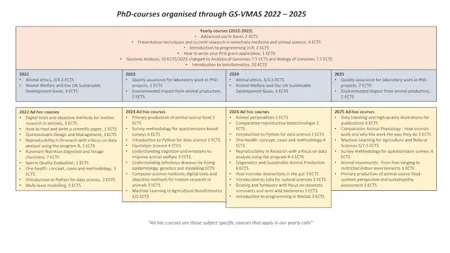
Previous PhD Courses (2022 - 2025)
Contact
-
Graduate School for Veterinary Medicine and Animal Science (GS-VMAS)