Cation Exchange Capacity and Base Saturation
Soil particles are electrically charged and can bind ions from the soil solution. The binding is non-specific, meaning that all ions with an opposite charge can bind. The ions are not fixed to a specific site but are exchangeable and can be replaced by other positively charged ions.
Cation exchange capacity
Cations (+) are bound to negatively charged surfaces and anions (−) to positively charged surfaces. The soil’s ability to bind cations to particle surfaces is called cation-exchange capacity (CEC). The corresponding concept for anions is called anion exchange capacity (AEC).
In Sweden, most soils have a substantially higher CEC than AEC. One consequence is that cations are retained more effectively in soils than anions. Examples of exchangeable cations include calcium (2⁺), magnesium (2⁺), potassium (1⁺), ammonium (1⁺), hydrogen (1⁺), and aluminium (3⁺). Examples of anions include sulfate (2⁻), nitrate (1⁻), chloride (1⁻), and phosphate (3⁻). The numbers in parentheses indicate the ion charge.
The amount of bound ions depends on charge
The unit for exchange capacity is cmolc*kg⁻¹ (centimoles of charge per kg of soil). However, it is often expressed as mmolc*kg⁻¹ (millimoles of charge per kg of soil), or meq*kg⁻¹. A mole is an SI unit for amount of substance; one mole contains a fixed number of entities (atoms, molecules), equal to Avogadro’s constant (approximately 6.022 × 10²³).
The number of ions that can be bound per unit of surface charge depends on the charge of the ion. A given surface charge can bind twice as many potassium ions as calcium ions because potassium is monovalent while calcium is divalent. For this reason, exchange capacity is expressed in millimoles of charge rather than number of ions.
Clay minerals and humus determine ion-binding capacity
The soil’s capacity to bind ions is primarily associated with the smallest particles, especially clay minerals and humus. Humus particles have a large internal surface area where ion exchange processes can occur. Clay-rich and humus-rich soils therefore generally exhibit high values of both CEC and AEC. Soils rich in precipitated iron and aluminium oxides have particularly high AEC. Organic matter in the humus layer can have a CEC of around 1000 mmolc*kg⁻¹, while clay minerals can range between 100 and 1500 mmolc*kg⁻¹.
Determination of cation exchange capacity
By summing the concentrations (in mmolc*kg⁻¹) of the exchangeable base cations (Ca²⁺, Mg²⁺, K⁺ and Na⁺) and total acidity (TA), the sample’s cation exchange capacity (CEC) is obtained:
CEC = ∑(Ca2+ + Mg2+ + K+ + Na+ + TA)
The magnitude of cation exchange capacity increases with pH. Therefore, CEC can be expressed in two different ways. In the expression above, the concentrations of exchangeable cations and total acidity are determined at pH 7. The resulting value of cation exchange capacity is sometimes referred to as potential cation exchange capacity or CECpH7.
The cation exchange capacity at the soil’s actual pH is called effective cation exchange capacity (CECeff). This value can be determined using an unbuffered extractant (e.g. NH₄Cl) and is sometimes used when the soil pH is clearly below 7.
An estimate of CECeff can be obtained by adding the exchangeable base cations (extracted with 1 N NH₄OAc solution buffered to pH 7.0) to exchangeable aluminium (extracted with 1 M KCl solution):
CECeff = ∑(Ca2+ + Mg2+ + K+ + Na+ + AlKCl)
Base saturation
The total base saturation (determined at pH 7.0) is a measure of the proportion of the cation exchange capacity (CEC) occupied by base cations, usually expressed as a percentage (%):
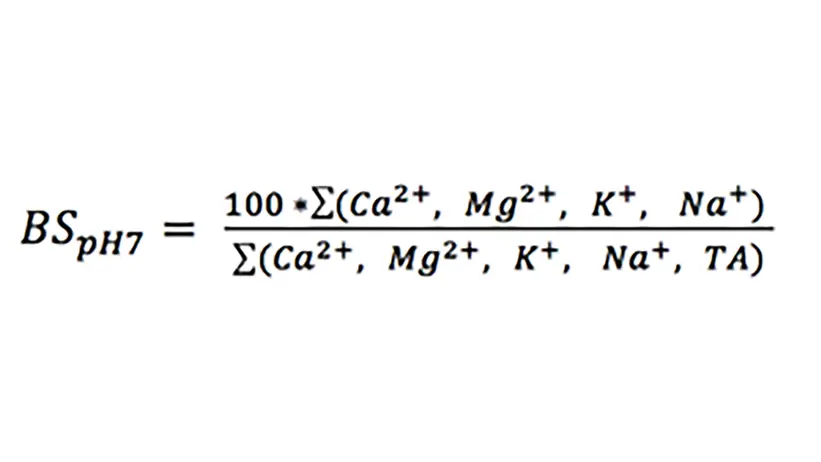
where Ca²⁺, Mg²⁺, K⁺ and Na⁺ are exchangeable base cations and TA = total acidity.
The effective base saturation (BSeff) corresponds to base saturation at the soil’s actual pH and is calculated as:
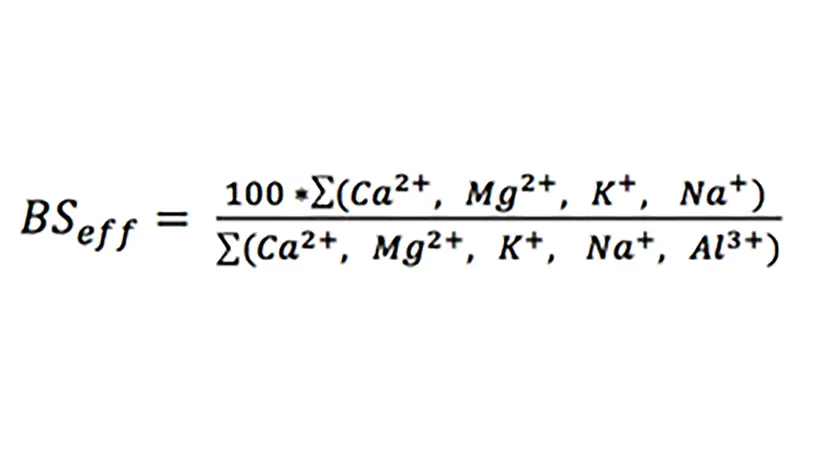
where Al³⁺ is exchangeable aluminium determined by extraction with 1 M KCl.
Effective base saturation (BSeff) is also expressed as a percentage (%).
Contact
-
PersonJohan Stendahl, head of department and researcherBiogeochemistry of Forest Soils