
About us
The SLU Forest Damage Centre engages in research, analysis, and monitoring of forest damage, which can result from factors such as storms, fires, plant pests, wildlife, or drought. We work to create opportunities for preventing and managing damage in the Swedish forest.
Forest damage affects both forest growth and biodiversity. An increased occurrence of various types of forest damage is expected due to ongoing climate changes. By generating and gathering knowledge about forest damage, we build the expertise needed to prevent and manage these damages.
We conduct our work in close collaboration with the Swedish Forestry Agency and other relevant authorities.
Our operations
Organisation
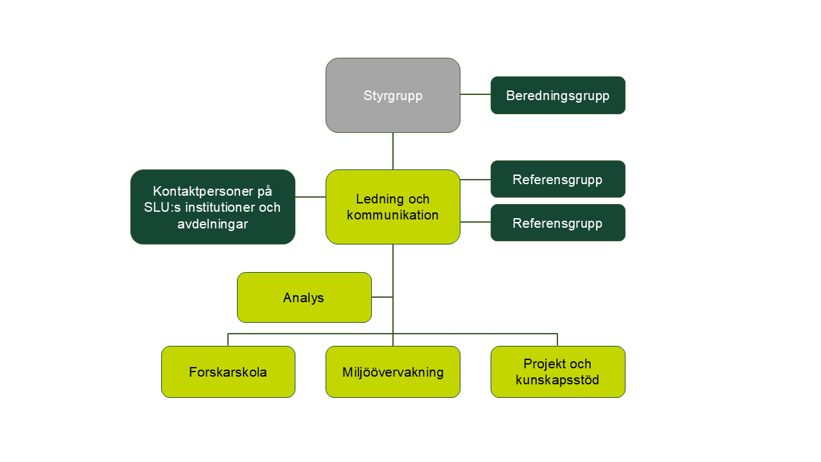
Steering group
The steering group for SLU Forest Damage Centre is appointed by SLU's rector. The group consists of representatives from SLU and external organisations. The steering group establishes plans, budget and reports for the centre.
Management and communications
The SLU Forest Damage Centre's management consists of a director, a deputy directors, a coordinator and a communicator. These have the task of leading, coordinating and following up the activities within the centre.
Reference group and contact persons
There is an independent reference group connected to the SLU Forest Damage Centre. The reference group provides insights on the practical application of received applications, contributes gap analyses for society's needs, and can propose ideas and focus areas to the management group. To enable information exchange between SLU institutions and units dealing with forest damage and the SLU Forest Damage Centre, a designated contact person is assigned at each relevant institution or unit.
Vision and goals
Vision
We produce and collect knowledge and competence for the health of the forest.
Mission statement
The SLU Forest Damage Centre conducts research, analysis and monitoring of forest damage. With a focus on responsible forest management, conservation of natural values and biodiversity, we contribute to a sustainable development of our society under changing climate conditions. We achieve this by developing knowledge and competence to prepare the Swedish forest for today's and future risks of damage.
General goals
- The SLU Forest Damage Centre will lead knowledge development in forest damage issues in Sweden.
- The knowledge and methods that the SLU Forest Damage Centre develops shall be characterized by high quality and be at the scientific forefront.
- The SLU Forest Damage Centre shall work for networks and collaboration that promote knowledge exchange regarding boreal and temperate forests between actors in the area.
- All researchers and analysts working with forest damage should feel a sense of belonging to the SLU Forest Damage Centre. An inclusive environment should be provided and integrated into the work of the SLU Forest Damage Centre.
- The SLU Forest Damage Centre works to ensure that scientific results and data are known and utilized in society, both in the short and long term. This encompasses monitoring data, analyses, forecasts, and methods that are essential for research and management, especially in the context of a changing climate and various forestry practices.
Our assignment
The SLU Forest Damage Centre is initiated by a government commission. Our assignment is to prevent, monitor and develop knowledge for managing forest damage caused by a wide range of pests. We make use of existing activities within SLU related to forest damage issues.
This means that we:
- Compile existing knowledge and identify knowledge gaps concerning abiotic and biotic forest damage.
- Generate new knowledge to prevent forest damage.
- Provide education and development of expertise in academia, government agencies, and practical forestry in the field of forest damage and climate adaptation. This development is carried out through undergraduate and graduate education as well as ongoing education.
- Continuously monitor damage and populations of known pests.
- Continuously analyze risks for damage outbreaks and their consequences.
- Manages the inventory model 'Target-tailored forest damage inventories (TFDI)' for inventories and compilations during outbreaks.
Our work is conducted in close collaboration with the Swedish Forestry Agency and other relevant authorities.
Analysis
We continuously analyze national risks for outbreaks based on existing data. We develop risk maps, create a basis for risk reduction, and conduct impact assessments. We compile existing knowledge and identify areas where knowledge is lacking. In the event of outbreaks and other incidents, we can provide knowledge support. Our analyses cover areas related to damage caused by:
- Insects
- Fungi, bacteria, and viruses
- Wildlife
- Fire and drought
- Wind and snow
- Socioeconomic consequences of damage
- Forest management
Read more about our analysis function and find contact information
Monitoring
We continuously collect data on damage and populations of pests in Swedish forest ecosystems. It is an important part of our work within the SLU Forest Damage Center to be able to follow damage outbreaks and suggest measures. Data provides valuable information and is a basis, primarily for our analyses, but is also used for research.
We integrate this inventory into the National Forest Inventory to obtain information on damage and populations of pests. Additionally, we conduct thematic monitoring to gather information about ungulates, bark beetles, and fungi. We manage the model for action-oriented damage inventory known as the 'Target-tailored forest damage inventories (TFDI)', which serves as support for authorities and landowners.
You can learn more about how we work with monitoring here
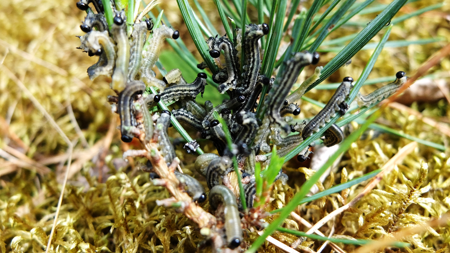
Research school
The SLU Forest Damage Centre's research school educates PhD students to acquire a broad expertise in the field of forest damage. Our research school is a vital component for both knowledge development in the field of forest damage and for supplying expertise to universities, research institutes, government agencies, and forestry companies. The research school is open to all doctoral students within SLU. We collaborates with external stakeholders who are invited to participate in the education.
Project and knowledge support
Research is an important part of our operation. We contribute with new knowledge about forest damage and pests, thereby creating oppertunities for the health of the Swedish forests. Our research develops knowledge, modeling tools, and techniques for preventing and managing forest damage. Research projects are driven by both initiatives and current needs within the field.
You can view all our projects on our project page
Contact
-
SLU Forest Damage Centre
Director: Jonas Rönnberg
Communicator: Theres Svensson
Deputy director: Wiebke Neumann Sivertsson
Coordinator: Katja Fedrowitz