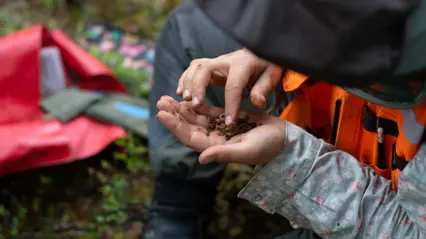
About the inventory
Here you can read about how our field inventory is carried out, which tasks are included, and what happens to the data we collect.
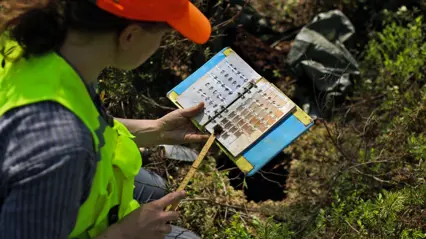
Data
Would you like to know more about our collected data and our database MiBas?
Markinfo
Results from the Soil Inventory are published in, among other places, the information system MarkInfo. The information is in Swedish,

Svampar i Sverige
Here you can view the results of the DNA samples collected by the Soil Inventory.
The greenhouse gas inventory
Read more about the greenhouse gas inventory and reporting to the UN and the EU.
Brief overview of the Soil Inventory
The Soil Inventory is part of the Swedish Environmental Protection Agency’s national environmental monitoring program. The inventory began in 1983 in collaboration with the Swedish National Forest Inventory and has since monitored the environmental status of Sweden’s forest soils and other natural lands. Each year, inventory and sampling are conducted at about 2,000 permanent sample plots. The samples are used for analyzing the soil’s chemical properties and determining the fungal community composition using DNA methods. The inventory produces data used in Sweden’s climate reporting to the UN and the EU, in national environmental goal follow-ups, in research, and as information for the public.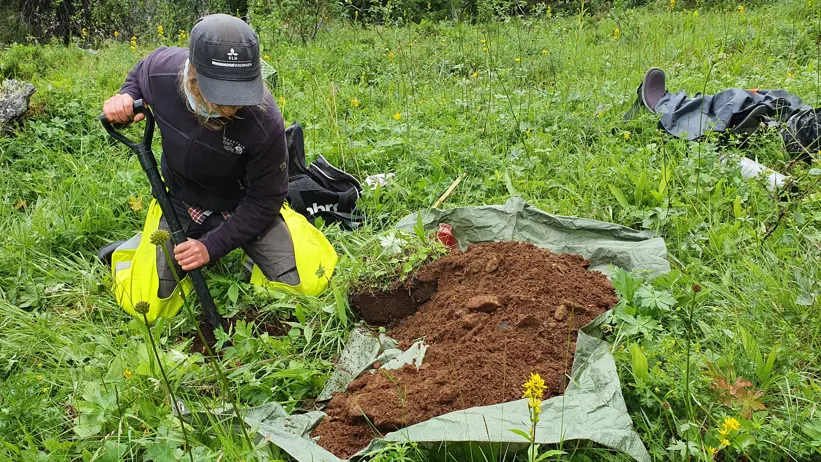
The inventory is conducted by the Department of Soil and Environment at SLU and falls under the Forest Program within SLU’s ongoing environmental analysis.
News
-
Forestry and mycorrhizal fungi: Species richness returns, but composition changes
Forests managed under current Swedish forestry practices experience a shift in the species composition of mycorrhizal fungi, yet they maintain the same number of species as forests that have never been clear-cut. This concludes a major new study from the SLU. -
Beyond clay content and fixed root-to-shoot ratios for organic carbon estimates in Swedish agricultural soils
Miyanda Chilipamushi is the author of a new doctoral thesis that evaluates sources of uncertainty in estimates of organic carbon storage in Swedish agricultural mineral soils. Her results open up for better decisions for soil management and climate mitigation in the future. -
Rare boreal deadwood fungi do not recover in clear-cut forests
Managed boreal forests support far less diverse fungal communities compared to successional forests sprung from forest fires. A new study from the Swedish University of Agricultural Sciences shows stark differences in the abundance of rare species between environments of different forest regimes. -
Cover crops reduce nitrogen leaching in a warmer climate
Climate change is expected to lead to increased nitrogen leaching in the Nordic countries. In his thesis, David Nimblad Svensson shows that growing cover crops is an important measure, that will become even more important in a future climate to reduce nitrogen leaching and preserve soil fertility. -
Spruce volume increases across Sweden – despite shrinking areas suited under future climate
Climate projections indicate that large parts of southern Sweden may become unsuitable for spruce by the end of this century. But the current management trends are moving in the opposite direction: spruce volume is increasing.