Research
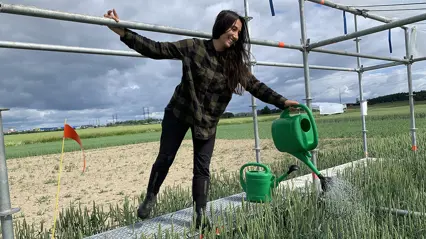
We develop ecological theories in order to understand how the world works. Our research is used within wildlife management, nature conservation, forestry and agriculture.
SLU Grimsö Wildlife Research Station
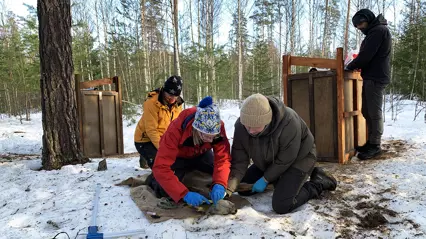
All year round, researchers and field staff at the SLU Grimsö Research Station work with monitoring, research and teaching och about wild animals.
International setting
We have doctoral students and researchers from around the globe. Our employees conduct field studies in places such as Greenland, Mongolia, Brazil and Rwanda. We collaborate with researchers from the entire world.
About us
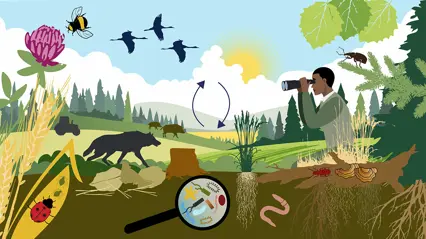
Here you will find contact information and an overview of the department's work in research, environmental analysis, teaching, and collaboration.
News & Events
News
-
Growing a broad set of crops does not threaten food security – quite the opposite
Crop rotations with a broad set of crops can produce more calories and nutrients than growing only cereals year after year. This result of an international study led by the Swedish University of Agricultural Sciences (SLU) challenges the common argument that diverse crop rotations produce less food. -
The memory of past land use is visible in the soil
Traces of historical land use remain visible in the soil for decades, according to a recently published study. Grasslands that were previously farmland contain different microbes than those without such a history, preserving memories of a bygone era. -
More variation in the field reduces nitrogen losses
How can agricultural nitrogen losses be reduced without compromising yields? New research from SLU shows that more varied crop rotations can lower emissions to the atmosphere while benefiting both the environment and farmers’ finances. -
Smart farming scares pests away – and lures them aside
Smallholder farmers in Africa struggle with weeds, insect pests and low soil fertility. The push-pull system, where crops are grown alongside other plants that scare away or attract pests, is one way of dealing with these problems. The method works – but not everywhere and not in the same way. -
Agroecology and Sustainable Intensification: the Values Beneath the Science
What does “sustainable agriculture” actually mean, and why do scientists disagree about it?
Research
Research projects
-
Microclimate and roadside plants (MicRoad)
We are investigating interactions between microclimate and roadside plant communities across Sweden. -
SKANDULV
Gränsen mellan Sverige och Norge skär genom vargens kärnområde i Skandinavien. Genom det skandinaviska vargforskningsprojektet (SKANDULV) samordnas forskningen om vargens ekologi. SKANDULV initierades i januari 1999.
Research groups
-
SKANDULV
The border between Sweden and Norway cuts through the wolf's core territory in Scandinavia. The Scandinavian wolf research project SKANDULV coordinates research on wolf ecology. -
Insect ecology - Ecology and Society
We are in the midst of a biodiversity crisis. To grasp the extent of what is happening, we need to understand the forces creating variation in organism diversity and numbers, how organisms interact with each other (including humans), and the repercussions in terms of ecosystem functioning. -
Biodiversity and biocontrol lab
We perform research on biodiversity and ecosystem services in agricultural landscapes. We study the links between biodiversity, food-web structure and service provisioning, and how farming practices and land use at different scales can be modified to support ecosystem services.