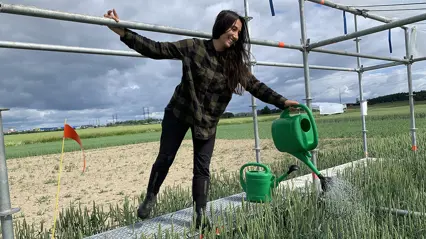
Department of Ecology

Climate change, biodiversity loss and competition for land are putting growing pressure on ecosystems – and on us, who depend on them. Ecological knowledge has never been more vital than it is today. We develop solutions for sustainable agriculture and forestry, plant protection with fewer toxins and effective conservation and wildlife management.

  • One of the Nordic region's largest centre for ecological research
  • Deep knowledge of insects, wildlife and soil organisms
  • A strong focus on interdisciplinary research and working closely with society

Research

We develop ecological theories in order to understand how the world works. Our research is used within wildlife management, nature conservation, forestry and agriculture.
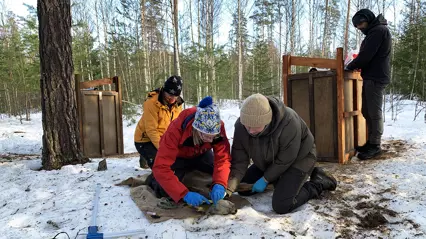
SLU Grimsö Wildlife Research Station

All year round, researchers and field staff at the SLU Grimsö Research Station work with monitoring, research and teaching och about wild animals.

International setting

We have doctoral students and researchers from around the globe. Our employees conduct field studies in places such as Greenland, Mongolia, Brazil and Rwanda. We collaborate with researchers from the entire world.
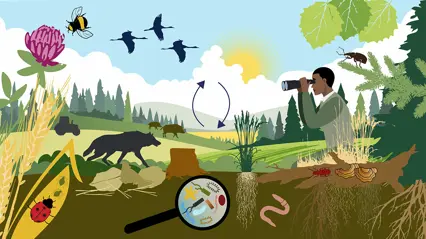
About us

Here you will find contact information and an overview of the department's work in research, environmental analysis, teaching, and collaboration.

News & Events

News

  • 2026-01-21

    What Counts as “Good Farming”? 

    How does values, assumptions, and disciplinary silos shape the future of sustainable agriculture? A new episode of the Feed podcast from TABLE discusses this based on a SLU study.
  • 2026-01-16

    Researchers sharpen bat monitoring with an open-access tool

    Bats are fascinating animals – and key players in natural ecosystems. Researchers are now developing a new tool for species identification that will support research, conservation and even bat watching.
  • 2025-12-03

    Insects could provide comfort for future space travellers

    Animals that accompanied long sea voyages in the past offered far more than food – they provided comfort and helped create routines for sailors. Insects could play a similar role on future space missions.

Calendar

Research

Research projects

  • 2025-01-01 - 2028-12-31
    2025-12-01

    Values and dependence of society on pollinators - VALOR

    VALOR aims to empower actors to better understand their relationship with pollinators and produces co-developed tools for landowners, businesses and policymakers to assess risks and undertake their own studies based on approaches  developed in VALOR.
  • 2026-01-08

    From field to flyway - geese and management

    We will investigate goose movements, responses to scaring, and how geese are perceived by people, with a particular focus on the Barnacle goose, the species causing the highest crop damage costs in Sweden. The results will provide important knowledge for effective goose management.
  • 2025-12-05

    Multifunctionality in agricultural ecosystems

    To keep agriculture within planetary boundaries, cropping systems must be redesigned for multifunctionality—managing ecosystem functions for productivity, environmental protection, soil fertility, climate mitigation and adaptation, and farm economy while minimizing trade-offs.

Research groups

  • 2025-06-10

    Insect ecology - Ecology and Society

    We are in the midst of a biodiversity crisis. To grasp the extent of what is happening, we need to understand the forces creating variation in organism diversity and numbers, how organisms interact with each other (including humans), and the repercussions in terms of ecosystem functioning.
  • 2025-06-16

    Biodiversity and biocontrol lab

    We perform research on biodiversity and ecosystem services in agricultural landscapes. We study the links between biodiversity, food-web structure and service provisioning, and how farming practices and land use at different scales can be modified to support ecosystem services.
  • 2025-06-16

    Ninkovic lab

    Plants can communicate with each other in different ways including chemical signalling. The aim of our research is to develop sustainable crop protection strategies based understanding of the interactions between plants, insects and their natural enemies.