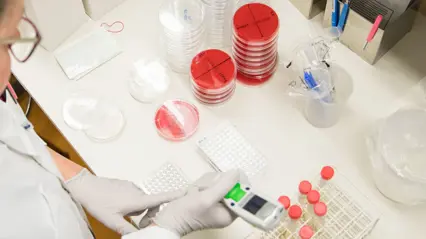
Infectious diseases and antimicrobial resistance
Infectious diseases and antimicrobial resistance (AMR), including antibiotic resistance, is a major challenge for animal husbandry and food security worldwide. Combating infectious diseases and AMR requires multidisciplinary global research.

Animals and nature for human health
Research investigating how animals and nature affect human health is performed at several SLU departments, and spans different research areas. Here we present a selection of current projects and publications in the field.
Translational and comparative medicine
Translational and comparative medicine bridges lab research and clinical practice, using animal models to find shared ways to improve both human and animal health.
Hi! What is your research about?
Meet some of our researchers and PhD students as they talk about their research within One Health. Together, they present the breadth of research taking place at SLU.

Meet SLU’s new Professor of One Health
Ingrid Ljungvall is SLU’s new Professor of One Health with a focus on Comparative Medicine. In this interview, she talks about her new role and how comparative medicine can strengthen One Health research at SLU.

Restoring landscapes for healthier people, animals and ecosystems
Can restoring forests and grasslands benefit people, livestock and nature? In this interview, Harry Fischer shares insights from a project in India exploring how ecosystem restoration may support biodiversity, food security, livestock health and human well-being.

Under the same roof: what can our pets tell us about the environment we share?
Humans and companion animals often share the same environment – but do we also share the same exposure to chemicals? In this interview, Ida Hallberg explains how studying our pets may help us better understand environmental health risks affecting both animals and people.

How breakdown products from antibiotics and antivirals impact rivers and lakes
Our results show that some antibiotic transformation products might retain antibacterial activity , which could be of interest to other sectors within One Health, especially considering the issue of antimicrobial resistance

What can bats tell us about pollution, ecosystems and health?
How do pharmaceutical pollutants move between ecosystems, wildlife and people? In this interview, Natalia Sandoval Herrera shares insights from a project exploring how bats can help us understand how contaminants move through food webs – and what this may mean for environmental, animal and human health.
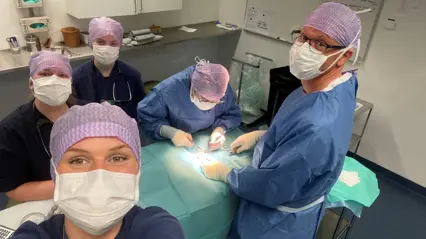
New surgical methods of benefit to both humans and animals
The materials mean that we don't have to harvest donor tissue (in humans, bone tissue is usually taken from the hip bone; in dogs, we usually harvest it from the "upper arm bone" humerus). Instead, those synthetic ceramic materials can be used, man-made bone graft material."

From health psychology to One Health – meet Nina Lind Ranneberg
Nina Lind Ranneberg has taken on the role of Programme Director for SLU Future One Health. With a background in health psychology and interdisciplinary research, she is keen to further strengthen collaboration across disciplines and highlight the breadth of One Health research at SLU.

When farmer well-being meets animal welfare
Improving calf welfare is not only about management and housing practices (e.g. feeding) – it is also about the people behind them. This interdisciplinary project explores how technology, working conditions and social sustainability are interconnected within a One Health perspective.

Reconnecting children with nature – a One Health perspective
Nature-rich environments play a key role in children’s health, development and social interaction. In this interview, Fredrika Mårtensson shares how access to biodiverse outdoor environments supports well-being – and why this matters from a One Health perspective.

Making valuable products from cassava residues
”By integrating food safety, environmental protection, and human well-being, my work reflects the core principles of the One Health approach”, says Andreia Massamby, new PhD at the Department of Molecular Sciences.

Coffee Chats: Making environmental research accessible
At the Department of Environmental Communication at SLU, new ways of communicating research are being explored. Through informal conversations over coffee, complex societal and environmental issues are made more accessible – closely linked to the One Health perspective.